
In my youth, I aspired to a career in politics and remained quite politically active well into my thirties. I even managed to get a political science degree along the way. Things moved in a different direction, and my activism is now more focused. Yet, I still fancy myself as something of an armchair politico.
I am a Democrat, and as I have explained in previous posts, I am probably liberal (especially on social issues) for the South but more moderate in comparison to other parts of the country. In recent years, I have found myself increasingly discouraged–almost downright cynical–about the polarized state of American partisan politics.
The Tennessee Presidential Primary takes place in early March, but early voting is now under way. (It’s such a wonderful convenience that all states need to implement, but I digress.) I will vote, as I always do, but I am disappointed that my own party seems so short on choices, but more importantly, I am saddened that the whole process seems stuck in a state of gridlock.
So, because I studied political science and work in the book industry, I have turned to books to try to better understand the lay of the land. I realize that not everyone wants to read in-depth about political topics, and the titles I am putting forth are all a few years old, but in terms of asking how we got here, I think the insights are quite valuable.
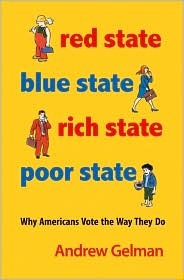
Red State, Blue State, Rich State, Poor State: Why Americans Vote the Way They Do by Andrew Gelman
Many of my fellow Democrats have watched election results that haven’t gone their way in the South and Heartland and lamented the apparent phenomenon of those of humble circumstances having embraced the Republican party wholeheartedly in this neck of the woods and voting against their class interests. Well, actually it’s complicated… Gelman’s research documents that differences in the behavior of affluent voters in Red and Blue States are what drive the differences in the American electoral map.
In states where overall incomes are low, residents on the higher end of the economic ladder skew so heavily Republican relative to those at the bottom that the landscape is altered entirely. On the other hand, in states where overall incomes are high, the rich don’t differ nearly as much as the poor in how they vote. There are a host of factors tied to race, religion, and culture shaping this divide, and I find the discussion quite fascinating.
The Big Sort: Why the Clustering of Like-Minded America is Tearing Us Apart by Bill Bishop
Given my interest in both politics and marketing, Bill Bishop’s perspective is addictive to me. As a Gen X member just a couple of years shy of 50, I have seen firsthand the trends he examines develop over the last three decades or so, for better and worse. Bishop explores how Americans–with so many more choices of where to live, where to shop, what to watch, and what to believe–create their own echo-chambers where they only have to listen to people just like themselves. Granted, it may not be a completely original idea, but Bishop does such an excellent job of showing us how that great middle ground of American consensus was lost.
Deer Hunting with Jesus: Dispatches from America’s Class War by Joe Bageant
Bageant recounts his journey home to rural Virginia after several decades in America’s liberal counter-culture. Yes, Virginia is the one patch of the former Confederacy that is actually becoming more blue thanks to the DC suburbs, but Bageant hails from a very different part of the state.
Bageant reminds me of Bernie Sanders; I think his policy ideas are probably too liberal for me, but I am grateful to him for raising those elephant in the room questions that others avoid. Bageant asserts that the working-class voters of his community really don’t have a voice on either side of the aisle, and politics often becomes a lesser of two evils kind of sideshow rather than a concrete means to make life better.
Stay warm, and don’t forget to vote early and often!
 Coloring Outside the Lines