
The Orange of My Eye: Why I am Hooked on the Women of Litchfield Penitentiary

Orange is the New Black Cast

As I have reached mid-life, I am actually less of a couch-potato than I was in my younger years. I try to find balance through reading, music, and  hobbies like my aquarium. I view television as something to consume in designated chunks when there is something I really want to see.

Around two decades ago, Netflix came on the scene with Internet-based mail order DVD rental and managed to completely disrupt what had been a bricks and mortar experience. As the years passed, the company altered their model to focus primarily on a video streaming service for their subscribers, Truth be told, the movie selection on the streaming offering is underwhelming, so my spouse and I also still hang on to our old-fashioned mail account. Yet, Netflix streaming does absolutely excel to incredible heights in the countless array of original series programming,

A few weeks ago, one of the company’s most high-profile shows–Orange is the New Blackreleased its fifth season. Part of the beauty of a streaming service is that viewers are free to either binge watch a new arrival all in one sitting or space it out a bit more. I am somewhere in the middle, but with my other half being a nurse who works nights and likes some of the same selections I do–I have to play it by ear.

I make it a point not to be one of the sheep/Kool-Aid drinkers who watches something only because it’s deemed hip by the trend setters. I don’t like someone telling me something is “must-see TV” as I figure I am the one who decides how to spend my time. Yet, for me at least, Orange–a women’s prison series that  occupies the space between edgy comedy and poignant drama–lives up to the hype.

In a few different respects, Orange seems akin to the darkly comedic M*A*S*H, one of the most groundbreaking television programs from my childhood and early teen years. Granted, the content, subject matter, and audience dynamics are quite different. Yet,  I see broad similarities in the sense of taking the most serious of settings and somehow managing to blend irreverent humor with engaging depictions of human tragedy and brokenness.

Taking Good Source Material and Reshaping to the Media Format
For those of you either old enough to remember or schooled in 1970s pop culture, M*A*S*H formed its basis on a Robert Altman film that was itself based on Richard Hooker’s Korean-War novel. The show’s creators managed to build a small-screen sensation–with eventual high ratings that kept it running for about four times longer than the actual length of the Korean War–by figuring out how to adjust the material to the venue of weekly half-hour television. Pulling off something like that counts as a pretty amazing skill in my book.

In the case of Orange, the  source material comes from Piper Kerman’s well-written memoir documenting her 13-month stay at a federal minimum-security prison. Kerman, a Smith College graduate from an affluent background, became swept up in shady dealings involving drug trafficking and money laundering. She documents her experiences–and those of her fellow inmates–in such a way that lets the stories take shape without minimizing the circumstances surrounding why folks are behind bars.

In the fictional series, a woman named Piper also serves as the original protagonist, and the circumstances of her background and crime are similar. There are several of the same memorable characters too, including both Crazy Eyes and Pennsatucky, but the situations in the nonfiction book are generally much more understated.  Granted, the “white collar” prison facility was by no means Club Med, but the conflicts depicted–interesting and enlightening as they may be to a reader–don’t quite provide the soap opera intensity needed to sustain a television project. So, the drama got kicked up a notch.

A Deceptively Simple Set Brought to Life with Magical Cinematography and Art Direction
M*A*S*H presented the austere conditions of wartime on a Hollywood set back when pretty much all television shows were filmed on a Hollywood set. The green tents were far from ornate, but somehow, the scenes still came to life in a way that rivaled the high art of the big screen. Camera angles captured just the right pose for the right emotional moment.

In an era when television producers compete with one another for the most ambitious locations,  Orange  interior shots actually originate from an honest-to-goodness New York area television studio, though an old psychiatric hospital does serve as the backdrop for exterior prison scenes. Yet, somehow the end result comes together with just the right look. I am no expert on the visual artistic aspects of show business, but I think that there are some real masters working in the stark motif.

Characters You Can’t Get Out of Your Head Played by Brilliant Performers
M*A*S*H the television show had a creative team with roots going back to the days of Vaudeville-styled comic reviews. So, it’s no surprise that, even in the midst of heavy-duty dramatic story lines, viewers were treated to the antics of a cross-dressing clerk on a futile quest for a Section 8 discharge, a sometimes bumbling but well-meaning chaplain, and a surgical team fueled by the potency of gin made in their own still.

Orange moves at a rapid  pace and encompasses a cast of characters way too large to do justice in an overview, but I have to focus on some of my personal favorite. Prison cook Red–who in the book was actually named Pop and hailed from Hispanic heritage–is a Russian mobster’s wife with an appreciation for the finer things in life and a rather volatile temperament. She is played to perfection by Kate Mulgrew, If forced to choose, I have to declare her as my favorite part of the show,

In terms of raw display of acting chops, its hard to beat Uzo Aduba as the previously mentioned Crazy Eyes, aka Suzanne Warren. Suzanne’s delusions often start out with an endearing childlike quality, but ultimately the sadness of someone who didn’t get the right kind of help at the right time comes through in a painfully sad fashion.

Taking Risks with Storytelling Narrative
Okay, 1970s edgy wasn’t exactly the same as edgy in today’s context, but I remember some inventive M*A*S*H  episodes that blew up the conventional rule books of the sitcom format, including one built entirely on dreams or another created from the point of view of the spirit of a recently deceased soldier that the doctors and nurses of the 4077 had sadly been unable to save.  That was pretty impressive stuff for the time.

Each episode of Orange  selects a character–usually an inmate but sometimes a guard–and provides a parallel story line from the past. In the case of the convicts, these mini-narratives take great pains to hint at the situations leading up–either directly or indirectly–to the crime for which the inmate was sentenced without fully playing out all the events, preserving an air of mystery that may be a bit frustrating for some viewers but that I actually appreciate.

One of my favorite flashbacks surrounds the past of Sister Jane Ingalls, imprisoned for her pacifist activism.  The events depict a surprising romantic element steeped in the idealistic beatnik era of the 1960s. I remember the episode closing with the Joan Baez version of the Pete Seeger folk anthem Where Have all the Flowers Gone. It’s not that I am a total pacifist, nor do I necessarily agree with the kind of bold action the Sister had taken in her youth, but for some reason the whole thing came together in such a stirring manner.

Closing Thoughts
I think it’s important to clarify that I think prisons exist for a reason. My views on crime and punishment are pretty balanced, and I don’t think it’s right to wallow in the idea that everyone in jail is the victim of something beyond his–or actually in this case–her control. Yet, at the same time, I do think that Orange does a decent job of telling stories that speak to the human condition.

I actually detest “lock-up” reality shows–the kind that MSNBC re-runs on weekends when there aren’t any big news events–with their exploitative appeal designed for pure shock value. Yet, that is not what Orange is about.  The content has some mature and controversial elements, so it’s not for everyone, but to me it’s television worth watching. I find myself entertained, but then I also feel challenged to think a bit too.

Three Memoirs That Read Like Captivating Novels

Today marks the kickoff of BookExpo America in New York, the annual event bringing together all facets of the American publishing industry into one place. In my day job, I work on projects that are tied to this major gathering, but I am content to mostly be a behind the scenes kind of guy with a few exceptions over the years. At any rate,  it seems like a fitting time to talk about the printed page a bit.

I possess rather eclectic tastes as a reader: fiction, nonfiction, literary, popular, you name it. Yet, if I have to choose the genre that I keep coming back to, it’s memoir/autobiography. More specifically, I am drawn to colorful real-life characters and human drama. As summer gets underway, here are three picks that are not brand new but are relatively recent releases, not lightweight necessarily, but still the kinds of books that can lure you in on a leisurely day.

A Thousand Naked Strangers: A Paramedic’s Wild Ride to the Edge and Back by Kevin Hazzard

Hazzard was a recent college grad in his early twenties trying to find his way in the fields of journalism and business, but something was missing. Following the September 11, 2001 terrorist attacks, Hazzard was jarred into making the radical career transition to become a first responder. He undertook a training program to serve as a paramedic on the streets of Atlanta, a sprawling metropolitan area encompassing both the glitter of the New South and some rather rough edges. Hazzard’s new line of work would focus more on the latter, to say the least.

Over the next decade, Hazzard would become entrenched in a world where life and death played out daily, complete with indelicate details of the human body. His evocative prose isn’t about pure shock value but rather letting the sheer humanity shine through the darkest of places. I found myself mesmerized by the journey.

Beer Money: A Memoir of Privilege and Loss by Frances Stroh

If you were around in the 1980’s and were old enough–or at least almost old enough–to drink beer, you will recall that Detroit-based Stroh Brewery made a leap from regional to national prominence with some clever branding that matched the big-hair excesses of the era. Yet, the empire began to falter and then collapsed completely as the feud-prone Stroh family couldn’t compete in the marketplace increasingly dominated by global conglomerates.

Stroh–who reached her teen years during this fateful era–documents the riches to rags story from within, as she enters the world as a fairy tale princess and eventually finds herself as a young adult picking up the pieces from both colossal business failure and dark family dysfunction. She is still standing, and her resilience seems tied to the fact that she managed to cultivate passions and ambitions beyond life as an heiress in the making. Ultimately, she has found her bliss in the arts and creativity. Yes, there are soap opera elements to the saga that are hard to resist, but Stroh’s example also manages to inspire.

The Sound of Gravel by Ruth Wariner

I am going to plagiarize from myself in summing up my reaction here, I think that’s allowed… I wrote this reaction on the Goodreads site, which I have come to adore as a resource for figuring out what to read next based on my own preferences and the reactions of other readers.

This little book really packs a powerful punch. It ventures into the realm of Glass Castle memoir writing, which is my gold standard. The topic is a young woman struggling to survive her upbringing in a polygamist cult. Yes, I know that sounds like one of those Oprah/Dateline episode staples, but the quality of the writing and the character and plot developments transcended my set expectations.

I know that I haven’t even scratched the surface of ideas out there. I just wanted to get the ball rolling. I encourage everyone to engage with their fellow readers–whether that be online or in person–to discover their next great read.

And the Envelope, Again Please… Why Moonlight Blew Me Away

Moonlight

As of today, I have seen seven of the nine Best Picture Oscar® Nominees. So far, I haven’t disliked any of them, but
Moonlight,
turned about to be the one that held me under a spell when I saw it three weeks ago. I really enjoyed the artistry of LaLa Land and don’t begrudge that film’s acclaim. Yet, my take on the musical was that it is the sort of thing that Hollywood is predisposed to honor because it’s about Hollywood. So, I began preparing this blog Sunday afternoon with the thinking that it was going to celebrate why Moonlight should have won Best Picture.

Well, it ended up being a strange night. La La Land dominated much of the evening, and thanks to an unprecedented envelope glitch, was revealed as the winner of the top prize at the close of the ceremony. Yet, in a bizarre twist, the victory speeches were interrupted with the news that an upset had indeed happened. So, the outsider contender that I and several others were championing overcame the odds.

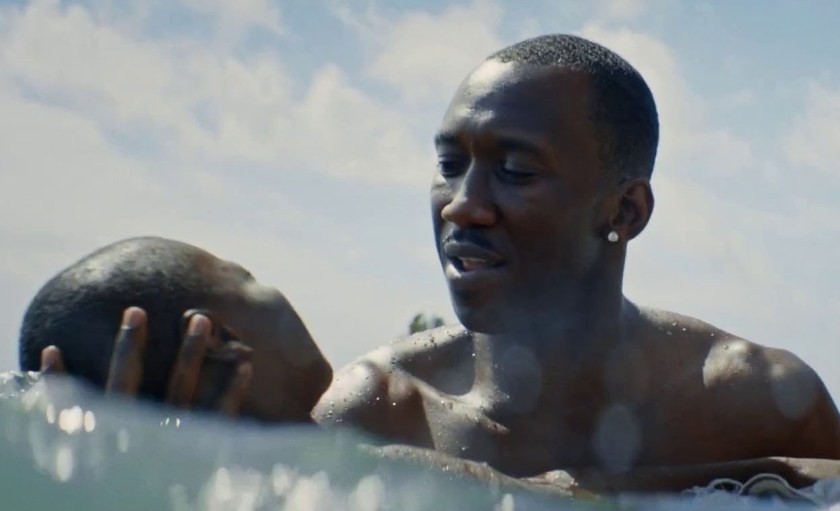
So, why did I Iove this little movie so much? I guess for me Moonlight  is one of those pieces of cinema that inhabits my head in the hours and days after I walk out of the darkened auditorium. The characters haunt me, and somehow I think about things a bit differently for having inhabited their world.

Based on a semi-autobiographical stage work by playwright Tarell Alvin McCraneyMoonlight traces the heart-wrenching coming of age journey faced by a youth named Chiron in Miami’s Liberty City neighborhood. Director Barry Jenkins co-wrote the film’s screenplay with McCraney, and the two men fused together aspects of their own childhoods.

Jenkins and McCraney came to the project with many common perspectives, though Jenkins is straight and McCraney had written the play from his formative experiences as a gay man. So, the two penned Chiron as a boy–and later a young man–who must face the double whammy of growing up amidst poverty, addiction, and violence and also coming to terms with being “different from other boys” on streets where machismo is a matter of life and death.

I will do my best to set the scene without revealing spoilers, as I do hope that more folks give Moonlight a try, whether on DVD (starting Tuesday February 28th) or in the theaters where it’s still playing. The Miami setting plays a large part in the film’s motif. Like many tourists, I have experienced the glitzy side of South Florida and its famous beaches, though the Liberty City neighborhood presents a very non-glamorous setting, but the ocean breezes and sandy beaches still manage to mesmerize.

Chriron’s mother Paula, played brilliantly by Oscar nominee Naomi Harris, wantonly neglects her son, caught up in crack cocaine and a host of related destructive behaviors. Chiron often finds himself either home alone or–perhaps even worse–stuck in the apartment with his mother when she is either coming down from her latest fix or desperately seeking her next.

The vulnerable young Chiron meets a strong and kind adult-male role model named Juan, played to absolute perfection by Oscar winner Mahershala Ali. Juan and his girlfriend Teresa have a warm and comfortable home where food is always on the stove and love is unconditional. Chiron finds a special safe place to spend his nights and weekends.

Juan and Teresa would qualify as a surrogate mom and dad figures straight out of Norman Rockwell Americana, complete with swimming lessons and other rites of boyhood. Yet, in an ironic twist, Juan’s middle-class lifestyle comes from his work as the very drug-dealer from whom Paula purchases her crack.

This contradiction makes me think of a couple of different classic Dickens novel, where the criminal figure is somehow the one doing the mentoring and/or material support of boys when there is no one else on the scene. And, Juan has many noble characteristics. He is one hell of a nice guy, really.  His stance of rationalization/justification almost seems convincing, almost. Yet, when one steps back and sees the legacy of crack, those warm fuzzies grow a bit cold.

The action picks back up when a teenage Chiron finds himself less and less able to “pass” in the presence of his peers. With his friend Kevin, he experiences the bliss of a same-sex romantic encounter and the pain of betrayal. The remaining events take shape in a roller coaster ride of emotions.

I was raised in  a white middle-class background in the rural South. So, I can’t relate to Chiron’s experiences related to urban crime and poverty.  Yet, as a gay man who spent my formative years trying to suppress and deny who I really was, the experiences of Chiron and his complicated relationship with Kevin hit rather close to home.

Sadly, gay boys–and gay men–have a track record for turning on each other when internalized homophobia and the pressure to conform to the wider society dominate. So, sometimes the result can be that those very individuals struggling with their own thoughts and feelings end up being at the heart of bullying behaviors.

I realize that this is by no means a novel concept among  story lines tackling gay issues, the “thou dost protest too much” character stuck in the closet. Moonlight moves beyond the movie-of-the week clichés and  sermonizing of  past offerings and strips things down into something refreshingly raw. More than any other movie about gay issues, Moonlight made me think about internalized homophobia that I had witnessed in my own life experiences, not necessarily violent in nature, but stinging nonetheless.

Moonlight is not a movie designed to appeal just to gay people. I think it’s a pretty universal story about acceptance and reconciliation. Yet, at the same time, I admire the fact that the film didn’t try to water down the sheer weight of gay identity at the center of Chiron’s struggle either. And ultimately, what makes it such an unforgettable film for me was how painstakingly real the characters become, which I think speaks to the top-notch work on both sides of the camera.

Wishing a Merry Christmas–Kinda Sorta–to the Folks Chomping at the Bit to Discriminate Against Me

Senator Ted Cruz
Senator Ted Cruz of Texas, a recent candidate for the Republican presidential nomination and co-sponsor of the First Amendment Defense Act

In the weeks that followed the bitterly contested presidential election last month, I contemplated weighing in via a blog post, but somehow it seemed that maybe too much had been said already. Maybe I was too overwhelmed by the magnitude of it all to unpack what I was thinking and feeling.

Yet, as I readied myself for the Christmas season, an article on my news feed grabbed my attention. Senators Ted Cruz of Texas and Senator Mike Lee of Utah–emboldened by the gains of their party–are reintroducing the “First Amendment Defense Act.”

This is a nationalized version of a trend that has taken hold at the state level and has generated a series of boycotts, and counter-boycotts. The introductory paragraph of the bill actually comes across rather broadly, “Prohibits the federal government from taking discriminatory action against a person on the basis that such person believes or acts in accordance with a religious belief or moral conviction that: (1) marriage is or should be recognized as the union of one man and one woman, or (2) sexual relations are properly reserved to such a marriage”. Yet, generally, the warm and fuzzy spin put forth involves well-meaning kind but firm Christian bakers who catch heat from civil-rights entities when they refuse to make a cake for a same-sex wedding.

Even though as a gay Christian I have embraced a different kind of faith experience than these individuals, I am not entirely unsympathetic to their plight. Granted, I wish they would broaden their horizons and check out the resources out there exploring where gay believers are coming from, but I understand that rather wide segment of folks–especially in the Bible Belt–live by a more Fundamentalist take on Scripture. So, being asked to script the names of two grooms or two brides in icing does probably upset the apple cart for at least some of them.

Also, as I have discussed earlier, my husband and I are pretty middle-of-the road gays who actually spend most of our time in majority-straight social settings and are reasonably comfortable in our own skin. There are aspects of our lives that are pretty traditional, and we don’t always fit nice and neat labels in the kind of scene that interests us.

Recently, we took an early winter getaway to a lovely tourist community in the mountains of Georgia. We could tell by the number of mom and pop businesses with Jesus fish in the signage that there were some rather strong Evangelical pockets, and the vibe was conservative. In fact, I was curious about how this county voted, so I Googled their election results, and sure enough Trump received 84% of the ballots that were cast.

Yet, we were treated with the utmost measure of hospitality and warmth every place we went. The motel clerks were delightful and didn’t care about our sleeping arrangements. Every single shop, restaurant, and attraction rolled out the red carpet for us. (I am not getting into the specifics of where and what, as I fear the travel guide shout-outs would distract from the issue at hand, but suffice to say, it was all good.)

So, I don’t necessarily view the landscape as there being a war against gay customers on the part of small businesses in the rural South and Heartland. For the most part, I believe that the power of the marketplace and the value of consumer purchasing power often keeps things in check, especially given the growing importance of the tourism and travel segment of the economy throughout the country.

However, in the words of Pee Wee Herman, there is a “big but” here. My but is that I realize there are some people in this world who would choose to be unwelcoming even when it flies in the face of their economic self-interest. Back to the proposed legislation at hand, the supporters may be fixated on the whole cake thing, but to me, it seems pretty clear that the language allows folks to get a pass on discriminating against gay people in pretty much any transaction as long as the motivation can be deemed as religious.

Do I sound alarmist? Well, maybe my views are shaped by what my parents taught me. My late father was a school principal in rural Western Kentucky. In the early 1960’s, racial segregation and integration operated in a bizarre patchwork throughout the Bluegrass State. When my dad was traveling with the very recently integrated sports teams as a chaperone, some eateries would allow all of his students to come in and be seated for a meal, and others would not.

My dad wasn’t trying to make things racial or political, He just wanted to make sure that his school kids could get fed. Thanks to the United States Congress and LBJ–an imperfect leader but still a saint of history from how I see things–segregated public accommodations became illegal. Granted, I don’t think this meant that everything suddenly became hunky-dory as far as race relations, but it was a huge improvement.

I wasn’t alive when all this was happening, but I came along just a few years later. While my political engagement is indeed rather moderate, social justice is a value to which I try to hold dear. I don’t want to make the assertion that the experiences of blacks and gays are exactly the same; that would be arrogant of me to do so. Yet, I do think that there are some parallels in that in both cases we are told that there is  a “right” not to accommodate a particular segment of the public in business.

I don’t claim to be a perfect Christian or to have all the answers on moral or spiritual matters. Yet, isn’t hospitality–the search for a room at the inn–at the heart of the Christmas story itself? That’s not to say that there aren’t going to be some rough patches with this concept about which we may not always agree, Yet, is it Christ-like to enshrine a license to discriminate against a particular group?

So, I know that as a Christian I am supposed to love all of humanity. I don’t think that has to mean Hallmark card syrupy sweetness though. Honestly, there is a part of me that would really love to place lumps of coal in the stockings of Cruz and his ilk this holiday season. Yet, to borrow a phrase from the recent political season, I am resolved to try to go high when they go low.

So, I wish the anti-gay crowd a kinda-sorta Merry Christmas. I think this country is in for a rough few years on this and other fronts, but I am grateful to have love and joy in my life, and no one can take that away.