The Hot Dog Lady Who Tried to Ruin Dollywood Christmas

“It’s sad when some people make up their minds about me before they can get to know me.” This is a quote from my beloved husband, Tom; we were married in 2015, one week after the United States Supreme Court said we could. We’ve actually been a couple since 2010 though.

I pretty recently passed the half-century mark, and Tom is not too far behind. So, we got together in mid-life, and it’s been a really blessed life together. We have a pleasant home, good jobs, supportive friends and family, and we manage to find plenty of interesting adventures to share together, some big and others small.,

We are Nashvillians and huge fans of Dolly Parton. In fact, she lives a few miles away from us, and we have seen her in a relatively rare concert appearance at the Ryman Auditorium here in Music City. We had been to the Smokies on several occasions in the past but had never visited Dollywood, so on the first weekend in December we headed to the theme park’s Smoky Mountain Christmas celebration.

Despite bursts of rain here and there, the experience was absolutely magical from start to finish. There were festive shows tailored to the holiday season.  The decorations and lights were beautiful, especially after sunset. We did have one negative experience pretty early in our day.  Tom and I didn’t let it spoil our fun, but its one of those little things that neither one of us could quite shake.

We planned our time around the many shows the park has to offer; we had one full day from 11 a.m. to 9 p.m. to get in all our fun. So, Tom and I hit the ground running finding one of the outdoor amphitheaters (Thankfully it wasn’t too cold.) where a Christmas bluegrass show was slated. We had a few minutes to spare, so we figured we would grab an early lunch, something that we could eat at the performance.

We saw a sign for a stand named “Dogs and Taters”. We got in line and noticed that the 70ish woman (I avoid labels related to age, as I have learned that they can be relative depending on where one lands on the chronological spectrum.) taking the orders was engaged in friendly banter with the four or five folks in line.

When it was our turn, we offered our usual pleasantries and inquired about the nature of the “taters” in question; were they home fries or homemade potato chips? The cashier seemed gruff and put upon in her response, and we noticed that she did not treat us with the same warmth that she had displayed to the others just mere seconds earlier.

The group in front of us consisted of male-female couples, probably retirees traveling together. The crowd overall seemed skewed either toward younger families with children or senior citizens.  Yes, we saw a few non-traditional families and/or same-sex couples in the park, so it’s not like we felt out-of-place in the grand scheme of things, but we were getting the impression that maybe this particular employee was not especially thrilled to be serving Tom and me.

We agreed that I would claim a bench in the amphitheater while Tom waited on our order. Tom ordered a hot dog and taters, while my carb-addict side made me opt for the corn dog and taters. Tom stood waiting, and then the cashier let him know that his food was ready. She handed him the hot dog and taters, and so he asked her about the rest of the order and provided our receipt. He was his usual unimposing and cheerful self; he just wanted the full order that we had paid for.

Ms. Congeniality managed to retrieve my corn dog and taters. She handed it to Tom with no thank you, no apology, no acknowledgement at all. She also didn’t seem concerned about whether he might need a tray, bag, etc to hold the ample-sized orders. It was as if any social interaction with Tom put her at the risk of bubonic plague.

I have done my time in the hospitality and retail industry. I know how difficult working with the public can be. We all have our bad-hair days, but it seemed telling that her problem was us in particular. Neither one of us is known for being a high-maintenance customer. We make it a point to be gracious and polite unless provoked for some strange reason.

As I have posted previously, my father was a school administrator during the arrival of school integration in rural Western Kentucky. He would recall the sad realities of the sports teams he traveled with being turned away at restaurants because there were African-American students in the group. By no stretch of the imagination am I deeming the little microaggression at Dollywood anywhere like the indignity of someone being flat-out denied service.

I am also well aware that Tom and I experience privilege in many facets of our lives. We enjoy positive interactions pretty much everywhere we choose to go. So, not a pity party at all. Yet, when Tom showed up with our food and reported on part two of the Dog and Taters saga, something still managed to sting a bit. We didn’t let it break our stride though. And the sit-down meal we had in the park that evening featured stellar service, perhaps because there was the matter of tipping or at least expected tipping.

On a purely transactional level, I figure that our money is as good as anyone else’s, so shouldn’t we be entitled to the basics of Customer Service 101? Yet, on a broader level, isn’t it sad that folks seem to have a way of assuming that different means less-than or something to be avoided?

I do stop and ask myself, are there situations when I make snap judgments based on external criteria? I must confess that I probably do; I think there is some degree of inevitable human nature involved. I make my assumptions, and they can be limiting in my thinking and attitude. Yet, I try not to let my expectations interfere with the task at hand in my daily life. That’s especially true of the workplace, but I think it also extends to other settings too.

I am resolved to try to light candles when I can rather than curse the darkness. In filling out an online guest survey, I reported the incident but stated that we still had an overwhelmingly positive experience overall.

In hindsight, I wish that I were the kind of person who would have gone back to the scene of the crime so-to-speak and found the perfect way to model congeniality and “kill her with kindness” through some sort of overt expression that would prove to Grouchy Lady that my beloved and I deserved her respect but that we were also respectful of her as well. Yet, I know that sometimes when I make moves like that, it comes across as being passive-aggressive, or worse, my long fuse manages to become lit in a not-so-healthy way.

At any rate, my hope is that I can be my best self and enjoy life so much that it’s contagious. There will be bumps along the way; I won’t be everyone’s cup of tea, and I will probably not always handle it with perfect ease. I wish that I could magically change the hearts and minds of those who think that Tom and I are the “other,” but maybe the answer is to keep an eye out for the hot dog ladies that do care and not miss out on the positive that’s out there.

Dollywood Nativity Scene

A Fun Little Getaway to the Site of the Scopes Monkey Trial

Front Page News
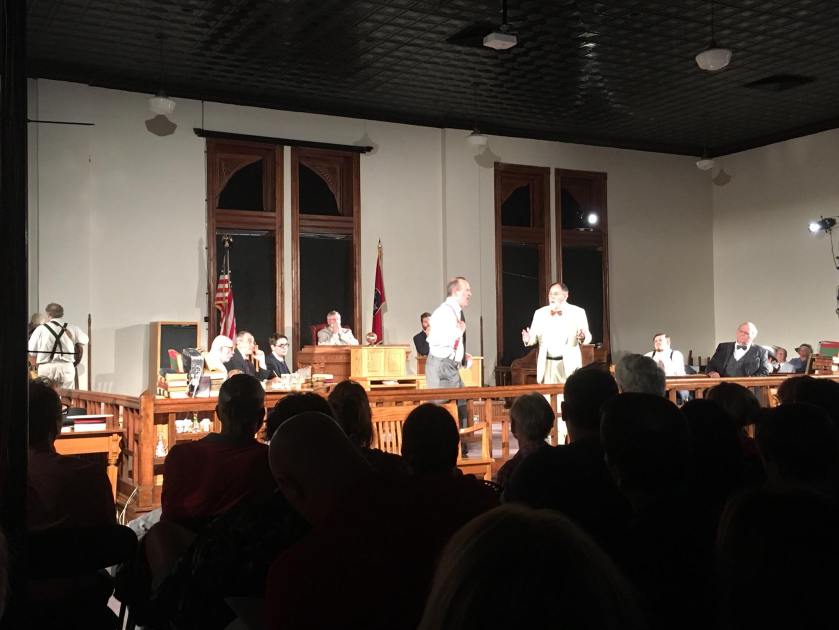
As part of the annual Scopes Festival, the play Front Page News is performed in the same Tennessee courtroom where the Scopes trial took place.

Sometimes, the places that are relatively close to where we live are the destinations that we say we want to visit when we “get around to it.” As shared in previous blog entries, my other half and I reside in Nashville. There are a wide array of day trips and weekend getaways in our neck of the woods. One of these–about a two and a half hours away from us–is Dayton, TN. A  couple of months ago, we made it there for the first time.

In the hot and sticky July of 1925, Dayton became the center of the media universe as site of the Scopes Monkey Trial. The proceedings happened to coincide with the earliest incarnations of national live news broadcasts by the rapidly growing medium of radio. Print journalists from major outlets across the country also made their way to the small mountain community roughly forty miles from Chattanooga.

The trial came about through a curious mixture of small-town tourist promotion with a desire on the part of both supporters and foes to test the heretofore unenforced Tennessee state law known as the Butler Act, which forbade the teaching of any scientific theory denying the biblical account of creation  (For a pretty decent timeline and synopsis of these events, check out a 2005 NPR item done in conjunction with the trial’s 80th anniversary. While much has been published about the proceedings and their aftermath, for a thorough book-length examination, I can personally vouch for Edward J. Larson’s Summer for the Gods.)

I have always maintained a deep fascination with the Scopes trial for a host of reasons. First, it marked a major turning point in the national dialogue concerning faith and science and the compatibility between the two. Also, the conflict established fault lines between the power of national religious identity and the rise of secularism. In a related twist, among Christian believers themselves, the split between evangelical/fundamentalist perspectives and more theologically liberal voices became more pronounced.

On a broader level, I think the “Roaring Twenties” holds a fair number of parallels with today.  America was grappling with changing social mores and the rise of modernity in national life. Also, immigration and urbanization had left wide swaths of the South and Heartland shaken by the changing face of America. Both then and now, trends can sow the seeds for countertrends.

Like many other folks, part of my interest in the Scopes case was fueled by watching the 1960 film Inherit the Wind, a fictional story based on the real-life events of the Scopes trial. Spencer Tracy is one of  my all-time favorite actors, and he shines in the character inspired by high-powered defense attorney Clarence Darrow. Likewise, Gene Kelly delivers an excellent portrayal of the equivalent to acerbic newspaper columnist H.L. Menken. And, I can’t leave out Fredric March for his turn as the figure modeled after fiery populist national political leader and religious crusader William Jennings Bryan.

Yet, as much as I adore the experience of watching the movie and appreciate the light it sheds on the debate about faith and science, some fine points bug me a bit. The film features Dick York–future Darrin #1 on Bewitched–in the role of the young teacher on trial for teaching evolution; he sits in a jail cell during the trial, an object of scorn and ridicule. In actuality, Scopes was never jailed, and punishment for violating the law was a 100 dollar fine. While the national political and cultural implications were indeed serious, the local origins of the case were more along the lines of a publicity stunt than a vendetta against Scopes.

At any rate, the trial came and went, and Scopes was found guilty as charged, though the conviction was later overturned on a technicality, and the Butler Act was repealed in 1967. In terms of the over-arching conflict, secularism and modernity carried the day in much of the wider culture and the media. Fundamentalism retreated to begin building up its own self-contained institutions, including a prominent college built in Dayton and named after  Bryan, who died suddenly while still in the town a mere five days after the trial’s conclusion. Decades later, similar conflicts would again play out on the national political stage and reshape the partisan political landscape.

Rhea County Courthouse
The Rhea County Courthouse in Dayton, Tennessee serves as the site for the annual Scopes Festival each July.
Scopes Museum
The Scopes Trial Museum in the basement of the Rhea County Courthouse houses artifacts and memorabilia related to the major 1925 media event.

Strangely enough, the tourism angle of the Scopes Monkey Trial took several decades to come to fruition. In the 1970s, a major renovation project restored the Rhea County Courthouse to its original glory, and a  museum devoted to the trial (remodeled in 2018) was added to the basement. In the 1980s, the annual Scopes Festival began as an opportunity for the community to commemorate the event that put it on the map.

The timing of the festival coincides with the anniversary of the trial itself. In addition to such staples as food and bluegrass music, the festival now includes the highly entertaining play Front Page News,  a re-enactment of the events surrounding the trial. As an added bonus, the drama plays out in the very courtroom where the actual trial happened.

Downtown Dayton
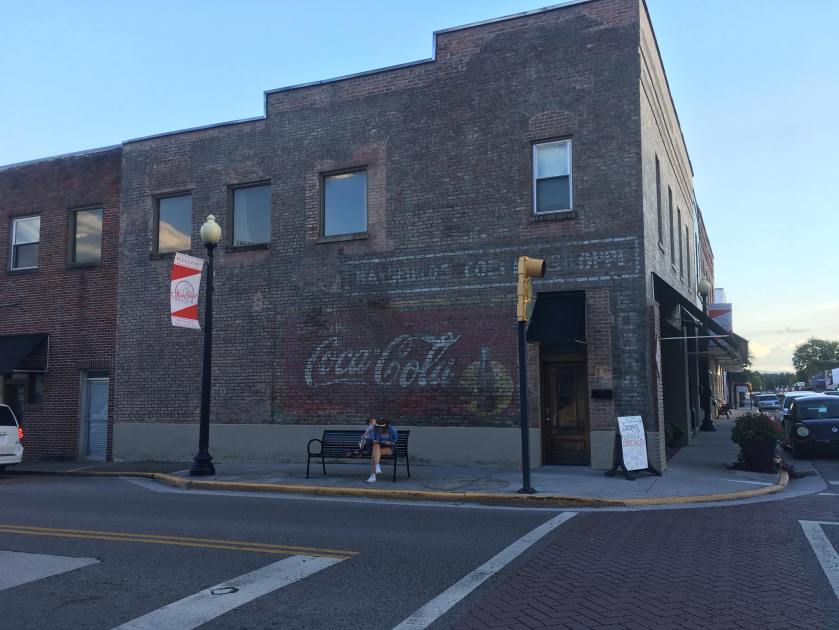
Here is some of the charming vibe of Downtown Dayton.
Monkey Town Brewery
In recent years, Dayton has undertaken a sometimes whimsical approach to its history.

The museum takes about an hour to tour, and it would be important to double-check on the open time and dates if making the trip to Dayton. We had a nice lunch at the Monkey Town Brewery and then sampled some of the excellent music on the courthouse lawn before and after the matinée of the play. It could have easily been a day trip for us, but we stretched things out by spending the night.

No, it wasn’t necessarily one of those action-packed getaways, but it was so enjoyable and enlightening to connect with a unique bit of history in the state where we live. If you are visiting  Chattanooga and have a bit of time to spare to make it over to Dayton, I think the museum is worth checking out in its own right. And, if you can make it to the Scopes Festival and the play when July comes around, even better.

Highlighting My Four Favorite Nonfiction Books of All Time

Midnight in the Garden of Good and EvilIn last month’s blog post, (you may start to notice a familiar pattern of my entries falling on the last days of the calendar months in an odd mix of procrastination and OCD)  I helped prepare for summer reading by revealing my five favorite novels of all time. Now it’s time to tackle nonfiction. For some strange reason, I am stuck on four rather than five; it is what it is.

As with last month’s selections, there is not necessarily an order overall, except for the fact that the first title on the list does happen to be my favorite book (regardless of genre) of all time. So, I guess I am kind of fuzzy on rules here, but it’s my blog. These are real-life stories that offer a memorable combination of the style of writing, the themes, or the people presented. Yes, it’s all subjective, but here goes….

Midnight in the Garden of Good and Evil: A Savannah Story by John Berendt

Midnight chronicles the protracted series of events surrounding the murder case against prominent Savannah antiques dealer Jim Williams for the shooting death of Danny Hansford, a young male escort with a long list of prominent clients (and would-be-clients) among the historic city’s elite circles. In a style that draws comparisons to literary giants Truman Capote and Norman Mailer, Berendt brings vivid attention to characters and setting to recount his time spent alongside Williams and a host of other Savannah residents.

As a devotee to the book, what stands out as I remember first devouring its pages back in the late nineties, is that the mysterious, eccentric, and charming city of Savannah itself takes center stage as the leading character. From the well-mannered precision of the Married Women’s Card Club to the banter of customers at the lunch counter of Clary’s Drug Store to the macabre beauty of Bonaventure Cemetery, the sense of place becomes palpable in a manner that transfixes the reading experience.

All Over But the Shoutin by Rick Bragg

Pulitzer Prize-winning journalist and author Bragg has drawn on his hardscrabble childhood in the Piedmont region of Alabama and his colorful family in multiple books, but if you want the best introduction to Bragg’s impressive body of work, start with this title recounting the gritty resilience of his resourceful mother and the emotionally haunted life journey of his father.

Southern storytelling seems to vacillate between extremes, where the fortunate get to embellish their tales of rich tradition and the not-so-fortunate become shocking caricatures to be pitied but not presented as possessing culture, ideals, hopes, and dreams. Bragg doesn’t sugarcoat the rough edges, but he never loses sight of the human dignity at the heart of his subjects. As an added bonus, if you listen to audiobooks, he is a fabulous narrator of his own material.

The Glass Castle by Jeannette Walls

Speaking of resilience, Jeannette Walls, who first made  a name for herself as a celebrity gossip columnist for New York  and Esquire magazines and MSNBC, chronicles a less than glamorous upbringing in her powerful autobiography. Though her parents both possessed considerable intellect and talent, through a combination of eccentricity and/or mental illness (a distinction perhaps open to interpretation), they raised their children off the grid in a vagabond existence.

As with Bragg, Walls challenges her readers to dig more deeply into the souls of the down-and-out, beyond the maudlin. The 2017  movie adaptation featured terrific performances from a top-notch cast, but I still think that the nuances of someone coming into peace and acceptance with the sordid and dysfunctional don’t quite play out as smoothly on the big screen as in print. I still recommend the film, but it’s no substitute for savoring the pages of this great book.

The Tender Bar by J.R. Moehringer

Speaking of dysfunction, how about a child raised in a pub? Well, that would be a bit of an exaggeration, but J.R. Moehringer hails from the Western Long Island community of Manhasset, New York. Manhasset holds a distinction for its rather high per-capita presence of liquor establishments and also its proximity to the real-life locales that inspired the gin-soaked antics of Fitzgerald’s Great Gatsby.

Raised by a single mother, Moehringer turned to the community around him for father figures. This included the men at a local watering hole. He also found purpose in his part-time job at the town’s branch of a bookstore chain where the staff managed the store and its inventory in a rather unorthodox fashion. The vivid descriptions of time and place manage to create something special here, even when the coming-of-age details seem pretty conventional at face value .

I realize that these picks probably slant heavily in the direction of my taste for the quirky. Yet, I would still make a pitch for any of them as solid choices for a great reading experience. Oh, and by the way, I just now thought of a possible number five, Frank McCourt’s Angela’s Ashes, but I will leave that as a last-minute aside rather than a full-fledged listing.

Keep cool everyone!

Highlighting My Five Favorite Novels of All Time

Confederacy of DuncesYesterday marked the kickoff of BookExpo America in New York, the annual event bringing together all facets of the American publishing industry into one place. Also, PBS has launched the Great American Read initiative, with voting to last through the summer. So, it seems like a fitting time to share my own reading favorites.

I figured that I would start with fiction. I plan to follow up with a post devoted to non-fiction picks in the near future. So, for now, here are my top five novels in no particular order. I guess my criteria entails books that resonated with me for some reason, a combination of the style of writing, the themes, or the characters. It’s all subjective, but here goes….

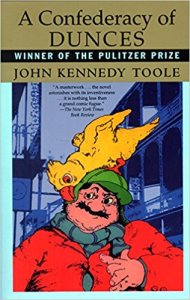
A Confederacy of Dunces  by John Kennedy Toole

Toole’s novel, published posthumously 11 years after the author committed suicide, captured the Pulitzer Prize for fiction in 1981. His mother had discovered the smeared manuscript among his possessions and undertook a long journey toward bringing her son’s creation to the literary world.

The darkly comic plot details the bizarre adventures of eccentric New Orleans resident Ignatius J. Reilly. Ignatius lacks the most basic of social graces and views contemporary society through a lens of mockery and disdain. He possesses an obsession with the elitist ideals of the Middle Ages. He is a man of extreme appetites and the most archaic of creative pursuits.

The storyline plays quite effectively against the backdrop of the Big Easy with all of its quirky charm. Toole creates a host of colorful  supporting characters just  as memorable as Ignatius. If you have a taste for sardonic wit and misfit perspectives, I highly recommend this modern classic.

A Prayer for Owen Meany by John Irving

Irving often gives rise to comparisons with Charles Dickens, and I agree with that assessment. His narratives take on a sweeping historical scope. Owen Meany may be familiar to movie fans as the inspiration for the 1998 film Simon Bircha good flick to be sure, but  one that zeroes in on a narrow and compressed portion of the novel’s complex timeline.

Yes, the book traces the  life experiences of a man remarkable for his short stature. Yet, Owen takes on so much more than his distinctive physical characteristics. Blessed with winsome charisma, he becomes a courageous everyman  for his generation during the upheaval of the 1960s and Vietnam War era.  Through the eyes of the narrator–his best friend John Wheelwright–the character of Owen takes up residence in my head, and that’s a good thing.

Beach Music by Pat Conroy

One of my favorite authors, perhaps my very favorite if someone were to force me to choose, the late Pat Conroy had a unique gift for painting mental pictures of time and place, particularly as it relates to the Low Country region of South Carolina, with his beautiful prose. And, he gave birth to characters that seem to come to life on the page.

Beach Music weaves together a rich tale of  resilience and reinvention in the face of heartache and family dysfunction. A widower comes to terms with the secrets of his late wife’s parents and his own mother and father. The book within a book approach delivers a powerful catharsis, and it’s the sort of read that leaves a lasting emotional imprint.

The Hour I First Believed by Wally Lamb

Also effectively utilizing the book within a book device, the novel masterfully connects divergent threads related to the staff and inmates at a women’s prison in Lamb’s native Connecticut with the horrific events of the 1999 Columbine shootings in Colorado. Yes, this represents a risky move, but Lamb is the consummate storyteller. There is the well-know metaphor of “the butterfly effect,” where the little seemingly random details of life and the universe usher in dramatic consequences; Lamb’s tale evokes that kind of experience.

The Great Gatsby by F. Scott Fitzgerald

Okay, I have to put at least one of the classics from my high school and college reading assignments on the list. I remember this novel as the first time that serious fiction I had to read for class became something in which I truly took pleasure. I guess what made such a powerful impression on me was Fitzgerald’s knack for presenting point-of-view, especially in regard to the title character Jay Gatsby.

The depiction of a self-made man feeling alone in the crowds at his own parties at his own colossal home managed to stick with me. Jay Gatsby remained a stranger in his own life, to borrow a phrase from Cheryl Crow. For Fitzgerald, this predicament was tied to the excesses of the Roaring Twenties era in which he wrote his masterpiece, but I think this theme speaks to the larger human condition.

There you have it. I am not claiming to provide a definitive list here, just a snapshot of a few books that I haven’t quite managed to get over, and I mean that in a positive sense. Happy summer reading.