
Trying–And Failing–To Build a Bridge While Cruising the Cumberland

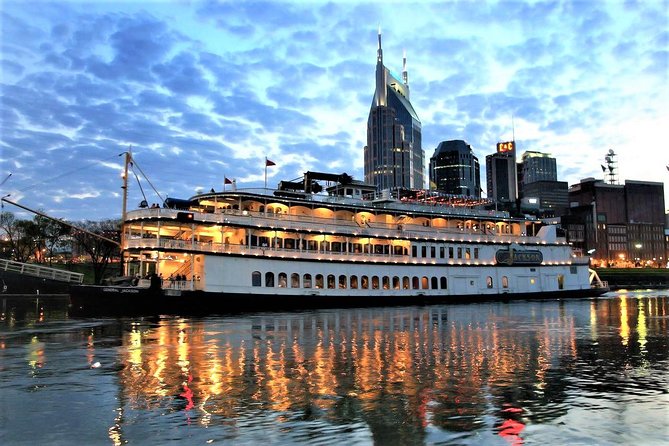
The_General_Jackson

My spouse Tom and I try to be reasonably friendly with strangers–at least in terms of basic civility–but given the hot-button situations out there, we also try to practice the sort of boundaries that prevent a potentially ugly scene. We look for clues with regard to how receptive folks might be to our situation, and we become especially mindful of when we might be stuck in an awkward shared seating or dining arrangement.

Late this past September, Tom and I found ourselves in one of those thorny encounters. We had just come out of two weeks of quarantine from a breakthrough COVID infection during the height of the Delta variant, so it felt especially good to get out of the house on a weekday evening and play tourists in our own city. We boarded Nashville’s General Jackson Showboat for a dinner show cruise; we had booked that evening’s sailing in particular, because a good friend of ours was part of the talented group of musicians performing.

Upon boarding, we found our assigned table and were soon joined by an outgoing middle-aged man and woman. We exchanged pleasantries and learned that they were celebrating their anniversary and had recently moved from Southern California to a rural enclave in one of the suburban counties outside of Nashville. Both husband and wife declared that they had fled the Golden State because they didn’t like “having their tax dollars support lifestyles they didn’t agree with.” Hmmm, just what lifestyles are those, we wondered, but of course we didn’t ask.

Another married straight couple arrived at the table. They identified themselves as tourists from Montana, where they own and operate a ranch. Please let me state for the record that I grew up in a rural community in Western Kentucky and maintain deep respect for folks from all settings and walks of life. So, no judgment intended, but the husband projected a rather bold and crass swagger in pretty much all his interactions.

The Montana wife was pleasant and soft-spoken, but in mere seconds, they both developed an instant kinship with the California-to-Tennessee refugee couple and firmly asserted their preference for Red State life and their disenchantment with all things urban and progressive. At this stage, Tom and I largely withdrew from the conversation.

I will give the California husband and wife credit, sort of, for trying to engage Tom and me in some chit-chat. They asked us if we were brothers and quizzed us about our family ties. I think we did end up stating that we lived in the same condo, but we did our best to keep our cards close to the vest, given the tenor of the other threads of conversation at the table. We don’t wear wedding rings, as Tom is not a fan of jewelry, but I still figured that at some point, we got our point across without exactly spelling out our nuptial status.

I know this always seems patronizing to say, but I have people I like and care about who hold political or religious views with which I don’t agree. It’s not a matter of me wanting ideologically segregated dining, far from it. Yet, in a communal setting with total strangers all trying to consume and digest their food, I think there is something to be said for trying to keep things on a superficial level until or unless all the parties involved seem comfortable with the line of questioning.

Thankfully, Tom and I were able to spend the time in between dinner service and the start of the show on the outdoor deck. We took snapshots of the lovely Nashville nighttime skyline and gave one another a chance to vent about our dining experience.

In our perfect world, we would just say “we are married,” and move on with wherever the conversation headed. Yet, in this particular situation, we didn’t muster the confidence to lay things on the table with that level of directness. That sounds cowardly, I realize, but then again, events later in the evening re-enforced our hesitation.

After parting the table with minimal discussion beyond the most generic of goodbye well wishes, we made it to the stage, where we caught up with our musician friend and chatted for a few minutes about how much we enjoyed the show. We then made our way to disembark the boat.

There were multiple corridors leading to the exit, and it was rather dark, so as we walked from one direction, we heard the couples from out table talking with one another, but I don’t think they saw or heard us. California wife was asking the Montana couple about whether they had been able to take in the honky tonks and other attractions in the Downtown tourist area. Montana husband replied that they had tried but that, “the queers were all over the place.”

My initial reaction was seething rage, but I didn’t engage. I just gave myself permission to mentally process my anger for a moment. (I won’t say what I was thinking at that exact moment, but it wasn’t pretty.) I realize that Montana husband was probably referring to visitors from the recent Nashville Pride Festival. I didn’t have a chance to hear any context or explanation from the overheard conversation, but I guess Montana husband thinks that we gays don’t need to flaunt our sexuality.

My response to such a complaint would be that we gay people have had to contend with straight people holding hands and displaying the nature of their relationship for a long time. We aren’t asking for anything different than the things that straight people already take for granted. Do Tom and I attend the Nashville Pride Festival every year at this stage in our lives? Not exactly, but I fully appreciate the affirming purpose these events serve for so many.

So, even though we might have seemed timid at the table, Tom and I aren’t going anywhere. We will continue to live our lives and not apologize to anyone. We are fulfilling our dreams and doing our best to be stand-up members of the community and decent humans. If anyone objects to that, well, it’s their loss, because I think we are worth getting to know. I can honestly say that, initial reactions aside, I don’t hold ill will toward our dining companions from that night. Tom and I are way too blessed in our lives to fixate on the haters.
The United Methodist Church’s LGBT Fracture and Wal-Mart’s Gay Shopping Date

Pride Flag with Male and Female Symbols

This week, I have taken a few vacation days to catch my breath and take care of some domestic matters. So, I have been able to ponder two media items related to the LGBT community. First, a special General Conference of the United Methodist Church narrowly adopted a conservative approach to issues of sexuality. Secondly, discount retailing giant Wal-Mart unveiled a new video advertisement on its Facebook feed featuring two gay men shopping at one of its Supercenters as part of a blind date. I know it seems like a huge apples to oranges stretch, but I can’t help tying these two media threads together in that pesky ADD brain of mine.

I have been a United Methodist my entire adult life. About the time I began my freshman year of college, the Southern Baptist denomination in which I was raised had swung from a pretty center-right brand of evangelical theology with a relatively big tent to a more rigid blend of religious and political fundamentalism. At the time, my coming to terms with being gay wasn’t destined to happen for another decade, but I possessed a keen sense that biblical literalism wasn’t for me. In particular, I strongly supported women in the ministry and the compatibility between Christianity and such scientific concepts as the theory of evolution.

I found my way pretty early on in this journey to the United Methodist Church, in large part, because of the supportive environment I found in my university’s excellent Methodist campus ministry. One of the foundational concepts of Methodism that appealed to me most strongly was the Wesleyan Quadrilateral. Okay, I never quite mastered correct pronunciation of that fancy ‘q’ word, but I loved the definition of faith shaped by “Scripture, tradition, reason, and experience.” I liked the idea that intra-Christian dialogue was more than just a Jeopardy Lightning Round Bible verse quote challenge.

As I accepted myself as a gay man who wished to remain a part of the Church, I found affirmation and assurance when I opened myself up to the growing number of supportive voices. I  have spent different periods of time actively involved in several wonderful United Methodist congregations that fell along the spectrum between the more bold left and the more live and let live center. I have been able to share my story in different ways in different settings.

I remain truly in awe of the many friends I have who have been on the front lines of LGBT issues in the United Methodist Church. I am grateful for their prophetic witness, particularly in the early years when I was either too young or not yet emotionally ready to come out of the closet. Such groups as the Reconciling Ministries Network and their allied organizations have fought the good fight over the past four decades.

Every four years, the United Methodist Church holds a General Conference of elected clergy and lay delegates to make decisions regarding church governance. Recurring battles have centered on issues of sexuality, in particular, whether to overturn existing bans on the ordination of homosexual clergy or allow same-sex weddings/commitment ceremonies in United Methodist Church buildings.

Over time, the vote tallies have gotten close, but the pro-LGBT side has always managed to come up a bit short. While there remains a vocal  and well-organized conservative contingency inside the United States, the most strident opposition has come from overseas conferences of the Church. I think it’s important to resist the temptation to make blanket statements that oversimplify things. Yes, there are allies in every corner of the world, but as a general trend, these regions are in a very different place both culturally and politically, and the split seems to be getting more pronounced with time.

The special 2019 off-year General Conference  was called to try to bring clarity and resolution to these matters and produce a “way forward” for the Church as a whole. The Council of Bishops put forth the middle-of-the-road One Church Plan as the recommended proposal for delegates. The One Church Plan was structured to place decisions about same-sex wedding ceremonies under the authority of local church pastors and decisions about LGBT ordination under the authority of the regional bodies known as Annual Conferences.

I am sure that some of the folks closer to the inside could offer nuance as far as the parliamentary procedures, but this gathering went against the wishes of the Bishops and instead adopted the Modified Traditional Plan, which doubles down on the existing prohibitions and seeks to make the Church’s divergent governing bodies more accountable for enforcement of those restrictions. (Approximately 2/3 of U.S. delegates supported the One Church Plan, not quite enough to make up for the opposition from elsewhere)

I feel deeply disappointed by this outcome, but I am grateful for the supportive messages I have received from my local church family this week. So, I guess I find myself wondering if the forces in support of inclusion and tolerance are not unlike Charlie Brown trying to counter Lucy’s football throws in Peanuts. We see ourselves getting closer, but the game keeps shifting, and it seems weighted toward the other side.

While, sadly, plenty of folks in our midst still face the pain of rejection for who they are and who they love,  I think that part of the current dynamic is that many in the LGBT community, including in the United Methodist Church, have made  quite a bit of progress in building relationships in our daily lives that have changed hearts and minds on hot-button questions. Usually, those interactions are built on shared connections, values, and cultural similarities. Take those away, and the change proves more of an uphill task.

I think that inviting someone from a completely different ethnic, cultural, or political situation to engage in discussion requires a special skill set. I hold a deep admiration for those who seek to spread a message of acceptance in parts of the world where such activity could get you arrested or killed. And even here in the United States, with all of the progress we have experienced, there are folks who have pure contempt and hatred for LGBT citizens and would do us harm if they could. Yet, because of all of the positive developments, many thriving, reasonably well-adjusted LGBT folks have carved out a life for ourselves tied to safe bubbles where we  do our best to avoid the loudest naysayers.

I am not saying that’s an inherently bad or good thing. It is what it is. It can seem like the best of times or the worst of times, depending on your particular circumstances. There are battles out there, but not all of us are on the front lines. If we aren’t, my hope is that we can still make a difference even if just by living our day-to-day lives with truth and integrity, refusing to be ashamed.

Which leads me, finally, to the Wal-Mart video. While the chain is now a ubiquitous phenomenon, its origins can be found in America’s rural South and heartland. Those of us from the Bible Belt got to know Wal-Mart before it operated from coast to coast and even across the globe. So, the chain has more socially conservative roots than its closest competitors. Yet, over the years, Wal-Mart has still become increasingly responsive to the LGBT consumer segment.

The advertisement in question features two clean-cut young men meeting for a blind shopping date. They dress far from provocatively and discuss such innocuous topics as shampoo-conditioner combinations, the joys of Little Debbie Oatmeal Cream Pies, and whether iron or aluminum cookware should be a new cook’s first purchase. Of course, that doesn’t stop a couple of pro-family groups from threatening boycotts due to the flagrant “gay agenda” at work.

However, unlike with other social and political institutions, I would venture to predict, with almost 100% certainty, that the angry mobs will get absolutely nowhere in their efforts. As with Target, Home Depot, Starbucks, and scores of other examples over the years–the most powerful forces in corporate America have come to understand that LGBT households are a force to be reckoned with. Okay, maybe not with a particular chicken sandwich restaurant and one individual arts and crafts chain, but those are definitely exceptions to the rule. Hating on gays gets you pretty much nowhere in a dialogue with contemporary consumer commerce giants.

So, maybe if you want to see the most reliable and unapologetic markers of social change, look to the shampoo and conditioner aisle. The political and religious stuff is more of a long game, I am afraid.

The Hot Dog Lady Who Tried to Ruin Dollywood Christmas

“It’s sad when some people make up their minds about me before they can get to know me.” This is a quote from my beloved husband, Tom; we were married in 2015, one week after the United States Supreme Court said we could. We’ve actually been a couple since 2010 though.

I pretty recently passed the half-century mark, and Tom is not too far behind. So, we got together in mid-life, and it’s been a really blessed life together. We have a pleasant home, good jobs, supportive friends and family, and we manage to find plenty of interesting adventures to share together, some big and others small.,

We are Nashvillians and huge fans of Dolly Parton. In fact, she lives a few miles away from us, and we have seen her in a relatively rare concert appearance at the Ryman Auditorium here in Music City. We had been to the Smokies on several occasions in the past but had never visited Dollywood, so on the first weekend in December we headed to the theme park’s Smoky Mountain Christmas celebration.

Despite bursts of rain here and there, the experience was absolutely magical from start to finish. There were festive shows tailored to the holiday season.  The decorations and lights were beautiful, especially after sunset. We did have one negative experience pretty early in our day.  Tom and I didn’t let it spoil our fun, but its one of those little things that neither one of us could quite shake.

We planned our time around the many shows the park has to offer; we had one full day from 11 a.m. to 9 p.m. to get in all our fun. So, Tom and I hit the ground running finding one of the outdoor amphitheaters (Thankfully it wasn’t too cold.) where a Christmas bluegrass show was slated. We had a few minutes to spare, so we figured we would grab an early lunch, something that we could eat at the performance.

We saw a sign for a stand named “Dogs and Taters”. We got in line and noticed that the 70ish woman (I avoid labels related to age, as I have learned that they can be relative depending on where one lands on the chronological spectrum.) taking the orders was engaged in friendly banter with the four or five folks in line.

When it was our turn, we offered our usual pleasantries and inquired about the nature of the “taters” in question; were they home fries or homemade potato chips? The cashier seemed gruff and put upon in her response, and we noticed that she did not treat us with the same warmth that she had displayed to the others just mere seconds earlier.

The group in front of us consisted of male-female couples, probably retirees traveling together. The crowd overall seemed skewed either toward younger families with children or senior citizens.  Yes, we saw a few non-traditional families and/or same-sex couples in the park, so it’s not like we felt out-of-place in the grand scheme of things, but we were getting the impression that maybe this particular employee was not especially thrilled to be serving Tom and me.

We agreed that I would claim a bench in the amphitheater while Tom waited on our order. Tom ordered a hot dog and taters, while my carb-addict side made me opt for the corn dog and taters. Tom stood waiting, and then the cashier let him know that his food was ready. She handed him the hot dog and taters, and so he asked her about the rest of the order and provided our receipt. He was his usual unimposing and cheerful self; he just wanted the full order that we had paid for.

Ms. Congeniality managed to retrieve my corn dog and taters. She handed it to Tom with no thank you, no apology, no acknowledgement at all. She also didn’t seem concerned about whether he might need a tray, bag, etc to hold the ample-sized orders. It was as if any social interaction with Tom put her at the risk of bubonic plague.

I have done my time in the hospitality and retail industry. I know how difficult working with the public can be. We all have our bad-hair days, but it seemed telling that her problem was us in particular. Neither one of us is known for being a high-maintenance customer. We make it a point to be gracious and polite unless provoked for some strange reason.

As I have posted previously, my father was a school administrator during the arrival of school integration in rural Western Kentucky. He would recall the sad realities of the sports teams he traveled with being turned away at restaurants because there were African-American students in the group. By no stretch of the imagination am I deeming the little microaggression at Dollywood anywhere like the indignity of someone being flat-out denied service.

I am also well aware that Tom and I experience privilege in many facets of our lives. We enjoy positive interactions pretty much everywhere we choose to go. So, not a pity party at all. Yet, when Tom showed up with our food and reported on part two of the Dog and Taters saga, something still managed to sting a bit. We didn’t let it break our stride though. And the sit-down meal we had in the park that evening featured stellar service, perhaps because there was the matter of tipping or at least expected tipping.

On a purely transactional level, I figure that our money is as good as anyone else’s, so shouldn’t we be entitled to the basics of Customer Service 101? Yet, on a broader level, isn’t it sad that folks seem to have a way of assuming that different means less-than or something to be avoided?

I do stop and ask myself, are there situations when I make snap judgments based on external criteria? I must confess that I probably do; I think there is some degree of inevitable human nature involved. I make my assumptions, and they can be limiting in my thinking and attitude. Yet, I try not to let my expectations interfere with the task at hand in my daily life. That’s especially true of the workplace, but I think it also extends to other settings too.

I am resolved to try to light candles when I can rather than curse the darkness. In filling out an online guest survey, I reported the incident but stated that we still had an overwhelmingly positive experience overall.

In hindsight, I wish that I were the kind of person who would have gone back to the scene of the crime so-to-speak and found the perfect way to model congeniality and “kill her with kindness” through some sort of overt expression that would prove to Grouchy Lady that my beloved and I deserved her respect but that we were also respectful of her as well. Yet, I know that sometimes when I make moves like that, it comes across as being passive-aggressive, or worse, my long fuse manages to become lit in a not-so-healthy way.

At any rate, my hope is that I can be my best self and enjoy life so much that it’s contagious. There will be bumps along the way; I won’t be everyone’s cup of tea, and I will probably not always handle it with perfect ease. I wish that I could magically change the hearts and minds of those who think that Tom and I are the “other,” but maybe the answer is to keep an eye out for the hot dog ladies that do care and not miss out on the positive that’s out there.

Dollywood Nativity Scene

Love, Simon Breaks New Ground by Being Conventional

Love, Simon
Nick Robinson stars as a high-school student coming to terms with his sexuality in Love, Simon

Love, Simon marks a major milestone as the first major release of a mainstream gay-themed romantic comedy-drama both about–and marketed to the–the teen audience. Gay characters have certainly found their way into plenty of teen-related movies over recent decades, but the dynamic tended to fall either into the realm of colorful comic-relief sidekicks or super-serious examples of repression and suffering.

Based on the acclaimed 2015 young-adult novel Simon vs. the Homo Sapiens Agenda,  Love, Simon tells the story of 16-year-old Simon Spier, a well-adjusted boy next door in the Atlanta suburbs with supportive family and friends. Simon flies under the high-school radar by not fitting stereotypes, but his romantic attempts involving the opposite sex have proven awkward, and he privately realizes that he is attracted to other guys.

As a gay man in midlife, watching the movie provided a catharsis of sorts. I spent  my entire young adulthood unable to come to terms with who I was. To witness today’s teens come to self-acceptance at a much earlier age warms my heart, but to be perfectly honest, it’s easy to fall into feelings of regret about the past and even envy for the apparent ease that I didn’t experience. Yet, ultimately, I can empathize with the commonalities and understand that everyone’s journey is shaped by time, place, and circumstances.

The storyline of Love, Simon fits the familiar structure of teen romantic comedy dramas. Simon anonymously corresponds with another boy from his high school who is secretly gay. When an obnoxious acquaintance sees Simon’s still-open Web browser in the library,  the closeted Simon finds himself blackmailed to play matchmaker, undertaking a scheme that wreaks heterosexual romantic havoc among his close-knit circle of friends. At the same time, Simon searches for clues surrounding the identity of his secret same-sex suitor, facing a series of embarrassing mixed signals.

Love, Simon seems a far cry from the gay-teen world of 2016’s MoonlightBullying exists, but it’s not a matter of life and death, and being gay presents challenges but not the heaviest type of heart-wrenching drama. So, which narrative rings truer? Well, I think that’s one of those apples and oranges comparisons. There are all kinds of gay lives running a wide gamut.

It seems to be that gay-themed movies, television shows, books, etc. invariably fall into the trap of gay people and their allies complaining that the situations are too stereotypical or too plain vanilla, too idealized or too doomed to tragic victim status, too political or not political enough, too edgy or not edgy enough. I think it’s human nature to look for our own experiences and the experiences of those around us.

I have to confess that, especially in my earlier years of coming out, I have found myself praising the “middle of the road” people-pleasing gay celebrities like Ellen Degeneres, privately wishing that some of the more in-your-face public figures would do a better job of public relations. When television sitcoms and dramas would feature gay characters, I  would often feel most drawn to situations that best defied stereotypes.

Over the passage of time, I have become better able to step back and take in the big picture. I realize that there is not just one gay experience or gay identity. It’s wrong to make assumptions and pigeonhole people and communities, and a big tent is the ideal.

I thoroughly enjoyed Love, Simon but can admit that the situations portrayed are idealized. There are certainly more dramatic and extreme stories that still need to be told. Yet, in my mind, the very existence of a movie like Love, Simon represents a sign of progress. As gay people become more visible in the wider culture, we can stand out, but we can also be conventional too.

I wish that there had been movies like Love, Simon in the 1980s. Yet, I can celebrate their arrival now and maybe let my inner teenager enjoy some of the fun too.