
Wishing a Merry Christmas–Kinda Sorta–to the Folks Chomping at the Bit to Discriminate Against Me

Senator Ted Cruz
Senator Ted Cruz of Texas, a recent candidate for the Republican presidential nomination and co-sponsor of the First Amendment Defense Act

In the weeks that followed the bitterly contested presidential election last month, I contemplated weighing in via a blog post, but somehow it seemed that maybe too much had been said already. Maybe I was too overwhelmed by the magnitude of it all to unpack what I was thinking and feeling.

Yet, as I readied myself for the Christmas season, an article on my news feed grabbed my attention. Senators Ted Cruz of Texas and Senator Mike Lee of Utah–emboldened by the gains of their party–are reintroducing the “First Amendment Defense Act.”

This is a nationalized version of a trend that has taken hold at the state level and has generated a series of boycotts, and counter-boycotts. The introductory paragraph of the bill actually comes across rather broadly, “Prohibits the federal government from taking discriminatory action against a person on the basis that such person believes or acts in accordance with a religious belief or moral conviction that: (1) marriage is or should be recognized as the union of one man and one woman, or (2) sexual relations are properly reserved to such a marriage”. Yet, generally, the warm and fuzzy spin put forth involves well-meaning kind but firm Christian bakers who catch heat from civil-rights entities when they refuse to make a cake for a same-sex wedding.

Even though as a gay Christian I have embraced a different kind of faith experience than these individuals, I am not entirely unsympathetic to their plight. Granted, I wish they would broaden their horizons and check out the resources out there exploring where gay believers are coming from, but I understand that rather wide segment of folks–especially in the Bible Belt–live by a more Fundamentalist take on Scripture. So, being asked to script the names of two grooms or two brides in icing does probably upset the apple cart for at least some of them.

Also, as I have discussed earlier, my husband and I are pretty middle-of-the road gays who actually spend most of our time in majority-straight social settings and are reasonably comfortable in our own skin. There are aspects of our lives that are pretty traditional, and we don’t always fit nice and neat labels in the kind of scene that interests us.

Recently, we took an early winter getaway to a lovely tourist community in the mountains of Georgia. We could tell by the number of mom and pop businesses with Jesus fish in the signage that there were some rather strong Evangelical pockets, and the vibe was conservative. In fact, I was curious about how this county voted, so I Googled their election results, and sure enough Trump received 84% of the ballots that were cast.

Yet, we were treated with the utmost measure of hospitality and warmth every place we went. The motel clerks were delightful and didn’t care about our sleeping arrangements. Every single shop, restaurant, and attraction rolled out the red carpet for us. (I am not getting into the specifics of where and what, as I fear the travel guide shout-outs would distract from the issue at hand, but suffice to say, it was all good.)

So, I don’t necessarily view the landscape as there being a war against gay customers on the part of small businesses in the rural South and Heartland. For the most part, I believe that the power of the marketplace and the value of consumer purchasing power often keeps things in check, especially given the growing importance of the tourism and travel segment of the economy throughout the country.

However, in the words of Pee Wee Herman, there is a “big but” here. My but is that I realize there are some people in this world who would choose to be unwelcoming even when it flies in the face of their economic self-interest. Back to the proposed legislation at hand, the supporters may be fixated on the whole cake thing, but to me, it seems pretty clear that the language allows folks to get a pass on discriminating against gay people in pretty much any transaction as long as the motivation can be deemed as religious.

Do I sound alarmist? Well, maybe my views are shaped by what my parents taught me. My late father was a school principal in rural Western Kentucky. In the early 1960’s, racial segregation and integration operated in a bizarre patchwork throughout the Bluegrass State. When my dad was traveling with the very recently integrated sports teams as a chaperone, some eateries would allow all of his students to come in and be seated for a meal, and others would not.

My dad wasn’t trying to make things racial or political, He just wanted to make sure that his school kids could get fed. Thanks to the United States Congress and LBJ–an imperfect leader but still a saint of history from how I see things–segregated public accommodations became illegal. Granted, I don’t think this meant that everything suddenly became hunky-dory as far as race relations, but it was a huge improvement.

I wasn’t alive when all this was happening, but I came along just a few years later. While my political engagement is indeed rather moderate, social justice is a value to which I try to hold dear. I don’t want to make the assertion that the experiences of blacks and gays are exactly the same; that would be arrogant of me to do so. Yet, I do think that there are some parallels in that in both cases we are told that there is  a “right” not to accommodate a particular segment of the public in business.

I don’t claim to be a perfect Christian or to have all the answers on moral or spiritual matters. Yet, isn’t hospitality–the search for a room at the inn–at the heart of the Christmas story itself? That’s not to say that there aren’t going to be some rough patches with this concept about which we may not always agree, Yet, is it Christ-like to enshrine a license to discriminate against a particular group?

So, I know that as a Christian I am supposed to love all of humanity. I don’t think that has to mean Hallmark card syrupy sweetness though. Honestly, there is a part of me that would really love to place lumps of coal in the stockings of Cruz and his ilk this holiday season. Yet, to borrow a phrase from the recent political season, I am resolved to try to go high when they go low.

So, I wish the anti-gay crowd a kinda-sorta Merry Christmas. I think this country is in for a rough few years on this and other fronts, but I am grateful to have love and joy in my life, and no one can take that away.
Thoughts on Stonewall and Orlando From a Moderate Gay Guy

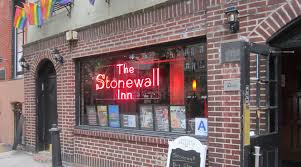
Stonewall Inn
Sometimes developments just seem too overwhelming for me to process all at once. Today marks the first anniversary of the momentous Supreme Court decision granting marriage equality to same-sex couples. And, in a related development, July 5th will mark my own first wedding anniversary.  President Obama also recently announced that New York’s Stonewall Inn will be designated as a historic monument for its role in the struggle for gay rights. Yet, just two weeks ago, a terrorist–perhaps motivated by both a militant strand of Islam AND internalized self-loathing homophobia– murdered 49 people in a Orlando gay nightclub.

As I have acknowledged in previous posts related to gay issues, I am open about who I am in all facets of my life. I am not necessarily a parade marcher per se, though I understand the value of parades and have logged my time working at Pride booths in the past. For my spouse and me, it just seems that we can accomplish more in the wider middle with supportive friends and family than inside the GLBT community specifically.

I understand  the role that gay bars have played in the history of the community and still play for many today. My spouse and I average about two or three visits to a gay club each year, generally to meet friends for a particular activity or function. It’s not that we don’t have fun; it’s just not our daily element. Yet, I know that part of why I can have that choice as a gay man living mostly in a mostly straight scene is that so many brave folks have paved the way through the years.

I truly believe that it takes all of us to make the world go around. In some of my past political involvement a decade or so ago, I got to know a very brave and savvy Democratic Party operative in Nashville who during  the 1990’s had worked  in the federal government dealing with HIV/AIDS issues. He told me that, during that time, groups such as ACT UP and Queer Nation performed an invaluable service in that they created the public stir in the streets that pushed the more centrist elements inside the Clinton White House to take action.

So, how do I unpack all of this? I am a gay man who lives a pretty fulfilling out life,  has a wonderful marriage with a terrific husband, goes to work at a decent job in a supportive workplace, owns a happy little condo  in a pretty generic white picket fence neighborhood,  goes to a church that is welcoming without necessarily flying the rainbow flag every Sunday, and has terrific friends and family.  All good, right?

Well, it’s not that simple. First, let me state for the record that I am incredibly blessed. I am so grateful for the litany that I just recited. I know that there are so many GLBT individuals of all ages who face hostile circumstances in all facets of their lives. And, if you feel burdened to try to help these folks, I suggest you find a worthy charity like Trevor Project for instance. When well-wishers gave us money to celebrate our wedding, we made a contribution to Trevor and felt rather blessed by doing so.

However, I must confess that, even when things look idyllic on the outside, there can be an ongoing internal monologue still happening. In my case, OCD symptoms can make it even worse, but that’s another possible blog topic. I am not saying that it rises to the level of me personally needing anyone’s sympathy or concern. Yet, after Orlando, I just figure that it needs to be a part of the discussion. Otherwise,  I fear that the issues will get side-tracked or become co-opted by some voices out there that really don’t know what they’re talking about.

PDA’s–Okay or Not Okay?
When my spouse and I are at the movies, there’s always the question of whether one of us gently but confidently reaching out to hold the other’s hand or putting an arm around the other’s shoulder might possibly cause a scene. In what part of town are we? What kind of movie are we watching? Does this look like the kind of audience where it’s okay to take that risk?

What about restaurants, hotel lobbies, cruise ships, or airplanes? It’s the same deal; we spend a fair amount of time trying to second-guess our surroundings. It’s not that we want to be in-your-face about anything, and we are not trying to prove anything to anyone. Rather, it is healthy and fulfilling to feel comfortable in one’s own skin. I do think that it’s getting much better than it used to be, but the fact that I feel so compelled to share my feelings about all of this means that there are still issues.

When to Reveal What?
Marriage equality has given us something tangible that has been worthy of celebrating. Yet, there can still be those little momentary mild anxiety-provoking moments. When we are filling out paperwork in various settings like the doctor’s office and such and have to clarify that “spouse” actually means husband rather than wife. Have I experienced a major ordeal over all of this? No, but I think it has to be acknowledged.

Same goes for a host of other settings both in our home communities and traveling other places. Do we introduce each other as husband and husband, or do we let ambiguity prevent possible awkwardness? It’s not a matter of wanting to hide like a puppy that’s afraid of being hit with a newspaper. We are not living in anyone’s closet, but I think it’s human nature to think about these kinds of potential encounters.

The Bottom Line
Lest you think that all of these reflections are pure conjecture, please be aware that marriage equality has not–thus far at least–brought with it the guarantee of equality on other fronts. In a majority of the states, it is perfectly legal to discriminate against someone for being gay in such areas as employment, housing, and education. Federal law that would address these matters across the board is one of the many casualties of DC gridlock.

Even if my life seems removed from the experiences of those people who pay a huge price for being gay, I can’t sit back and pretend that discrimination is a non-issue. Even when things improve through media awareness and visibility, discrimination anywhere is intolerable. I may not always march in the parades, but I  certainly remember that fact when I go to the polls and vote. And, I also make it a point not to hold my tongue when the naysayers complain about “special rights.”

When I hear certain political leaders imply that all the troubles faced by gay people will be solved by fighting ISIS, I can’t give a pass to that type of short-sighted thinking. Yes, we need to battle religious extremism at home and abroad. Yes, we also need to address guns and crime. However, the phenomenon of gay people needing a safe and supportive environment is much broader, and if someone in the public eye can’t at least acknowledge that, then my patience wears pretty thin.

Three Nonfiction Picks That Help Explain The Current Political Divide

RedStateBlueStateCover

In my youth, I aspired to a career in politics and remained quite politically active well into my thirties. I even managed to get a political science degree along the way. Things moved in a different direction, and my activism is now more focused. Yet, I still fancy myself as something of an armchair politico.

I am a Democrat, and as I have explained in previous posts, I am probably liberal (especially on social issues) for the South but more moderate in comparison to other parts of the country. In recent years, I have found myself increasingly discouraged–almost downright cynical–about the polarized state of American partisan politics.

The Tennessee Presidential Primary takes place in early March, but early voting is now under way.  (It’s such a wonderful convenience that all states need to implement, but I digress.) I will vote, as I always do, but I am disappointed that my own party seems so short on choices, but more importantly, I am saddened that the whole process seems stuck in a state of gridlock.

So, because I studied political science and work in the book industry, I have turned to books to try to better understand the lay of the land. I realize that not everyone wants to read in-depth about political topics, and the titles I am putting forth are all a few years old, but in terms of asking how we got here, I think the insights are quite valuable.

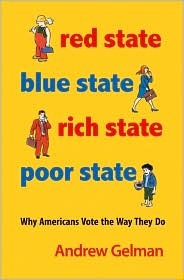
Red State, Blue State, Rich State, Poor State: Why Americans Vote the Way They Do by Andrew Gelman

Many of my fellow Democrats have watched election results that haven’t gone their way in the South and Heartland and lamented the apparent phenomenon of those of humble circumstances having embraced the Republican party wholeheartedly in this neck of the woods and voting against their class interests. Well, actually it’s complicated… Gelman’s research documents that differences in the behavior of affluent voters in Red and Blue States are what drive the differences in the American electoral map.

In states where overall incomes are low, residents on the higher end of the economic ladder skew so heavily Republican relative to those at the bottom that the landscape is altered entirely. On the other hand, in states where overall incomes are high, the rich don’t differ nearly as much as the poor in how they vote. There are a host of factors tied to race, religion, and culture shaping this divide, and I find the discussion quite fascinating.

The Big Sort: Why the Clustering of Like-Minded America is Tearing Us Apart by Bill Bishop

Given my interest in both politics and marketing, Bill Bishop’s perspective is addictive to me. As a Gen X member just a couple of years shy of 50, I have seen firsthand the trends he examines develop over the last three decades or so, for better and worse. Bishop explores how Americans–with so many more choices of where to live,  where to shop, what to watch, and what to believe–create their own echo-chambers where they only have to listen to people just like themselves. Granted, it may not be a completely original idea, but Bishop does such an excellent job of showing us how that great middle ground of American consensus was lost.

Deer Hunting with Jesus: Dispatches from America’s Class War by Joe Bageant

Bageant recounts his journey home to rural Virginia after several decades in America’s liberal counter-culture. Yes, Virginia is the one patch of the former Confederacy that is actually becoming more blue thanks to the DC suburbs, but Bageant hails from a very different part of the state.

Bageant reminds me of Bernie Sanders; I think his policy ideas are probably too liberal for me, but I am grateful to him for raising those elephant in the room questions that others avoid. Bageant asserts that the working-class voters of his community really don’t have a voice on either side of the aisle, and politics often becomes a lesser of two evils kind of sideshow rather than a concrete means to make life better.

Stay warm, and don’t forget to vote early and often!