
Three Memoirs That Read Like Captivating Novels

Today marks the kickoff of BookExpo America in New York, the annual event bringing together all facets of the American publishing industry into one place. In my day job, I work on projects that are tied to this major gathering, but I am content to mostly be a behind the scenes kind of guy with a few exceptions over the years. At any rate,  it seems like a fitting time to talk about the printed page a bit.

I possess rather eclectic tastes as a reader: fiction, nonfiction, literary, popular, you name it. Yet, if I have to choose the genre that I keep coming back to, it’s memoir/autobiography. More specifically, I am drawn to colorful real-life characters and human drama. As summer gets underway, here are three picks that are not brand new but are relatively recent releases, not lightweight necessarily, but still the kinds of books that can lure you in on a leisurely day.

A Thousand Naked Strangers: A Paramedic’s Wild Ride to the Edge and Back by Kevin Hazzard

Hazzard was a recent college grad in his early twenties trying to find his way in the fields of journalism and business, but something was missing. Following the September 11, 2001 terrorist attacks, Hazzard was jarred into making the radical career transition to become a first responder. He undertook a training program to serve as a paramedic on the streets of Atlanta, a sprawling metropolitan area encompassing both the glitter of the New South and some rather rough edges. Hazzard’s new line of work would focus more on the latter, to say the least.

Over the next decade, Hazzard would become entrenched in a world where life and death played out daily, complete with indelicate details of the human body. His evocative prose isn’t about pure shock value but rather letting the sheer humanity shine through the darkest of places. I found myself mesmerized by the journey.

Beer Money: A Memoir of Privilege and Loss by Frances Stroh

If you were around in the 1980’s and were old enough–or at least almost old enough–to drink beer, you will recall that Detroit-based Stroh Brewery made a leap from regional to national prominence with some clever branding that matched the big-hair excesses of the era. Yet, the empire began to falter and then collapsed completely as the feud-prone Stroh family couldn’t compete in the marketplace increasingly dominated by global conglomerates.

Stroh–who reached her teen years during this fateful era–documents the riches to rags story from within, as she enters the world as a fairy tale princess and eventually finds herself as a young adult picking up the pieces from both colossal business failure and dark family dysfunction. She is still standing, and her resilience seems tied to the fact that she managed to cultivate passions and ambitions beyond life as an heiress in the making. Ultimately, she has found her bliss in the arts and creativity. Yes, there are soap opera elements to the saga that are hard to resist, but Stroh’s example also manages to inspire.

The Sound of Gravel by Ruth Wariner

I am going to plagiarize from myself in summing up my reaction here, I think that’s allowed… I wrote this reaction on the Goodreads site, which I have come to adore as a resource for figuring out what to read next based on my own preferences and the reactions of other readers.

This little book really packs a powerful punch. It ventures into the realm of Glass Castle memoir writing, which is my gold standard. The topic is a young woman struggling to survive her upbringing in a polygamist cult. Yes, I know that sounds like one of those Oprah/Dateline episode staples, but the quality of the writing and the character and plot developments transcended my set expectations.

I know that I haven’t even scratched the surface of ideas out there. I just wanted to get the ball rolling. I encourage everyone to engage with their fellow readers–whether that be online or in person–to discover their next great read.
Three Nonfiction Picks That Help Explain The Current Political Divide

RedStateBlueStateCover

In my youth, I aspired to a career in politics and remained quite politically active well into my thirties. I even managed to get a political science degree along the way. Things moved in a different direction, and my activism is now more focused. Yet, I still fancy myself as something of an armchair politico.

I am a Democrat, and as I have explained in previous posts, I am probably liberal (especially on social issues) for the South but more moderate in comparison to other parts of the country. In recent years, I have found myself increasingly discouraged–almost downright cynical–about the polarized state of American partisan politics.

The Tennessee Presidential Primary takes place in early March, but early voting is now under way.  (It’s such a wonderful convenience that all states need to implement, but I digress.) I will vote, as I always do, but I am disappointed that my own party seems so short on choices, but more importantly, I am saddened that the whole process seems stuck in a state of gridlock.

So, because I studied political science and work in the book industry, I have turned to books to try to better understand the lay of the land. I realize that not everyone wants to read in-depth about political topics, and the titles I am putting forth are all a few years old, but in terms of asking how we got here, I think the insights are quite valuable.

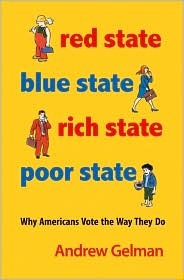
Red State, Blue State, Rich State, Poor State: Why Americans Vote the Way They Do by Andrew Gelman

Many of my fellow Democrats have watched election results that haven’t gone their way in the South and Heartland and lamented the apparent phenomenon of those of humble circumstances having embraced the Republican party wholeheartedly in this neck of the woods and voting against their class interests. Well, actually it’s complicated… Gelman’s research documents that differences in the behavior of affluent voters in Red and Blue States are what drive the differences in the American electoral map.

In states where overall incomes are low, residents on the higher end of the economic ladder skew so heavily Republican relative to those at the bottom that the landscape is altered entirely. On the other hand, in states where overall incomes are high, the rich don’t differ nearly as much as the poor in how they vote. There are a host of factors tied to race, religion, and culture shaping this divide, and I find the discussion quite fascinating.

The Big Sort: Why the Clustering of Like-Minded America is Tearing Us Apart by Bill Bishop

Given my interest in both politics and marketing, Bill Bishop’s perspective is addictive to me. As a Gen X member just a couple of years shy of 50, I have seen firsthand the trends he examines develop over the last three decades or so, for better and worse. Bishop explores how Americans–with so many more choices of where to live,  where to shop, what to watch, and what to believe–create their own echo-chambers where they only have to listen to people just like themselves. Granted, it may not be a completely original idea, but Bishop does such an excellent job of showing us how that great middle ground of American consensus was lost.

Deer Hunting with Jesus: Dispatches from America’s Class War by Joe Bageant

Bageant recounts his journey home to rural Virginia after several decades in America’s liberal counter-culture. Yes, Virginia is the one patch of the former Confederacy that is actually becoming more blue thanks to the DC suburbs, but Bageant hails from a very different part of the state.

Bageant reminds me of Bernie Sanders; I think his policy ideas are probably too liberal for me, but I am grateful to him for raising those elephant in the room questions that others avoid. Bageant asserts that the working-class voters of his community really don’t have a voice on either side of the aisle, and politics often becomes a lesser of two evils kind of sideshow rather than a concrete means to make life better.

Stay warm, and don’t forget to vote early and often!

Another Audiobook Review: Jenny Lawson’s Furiously Happy

Furiously Happy

I was pleased to see the finished product of my recent review of the audio edition of Furiously Happy: A Funny Book About Horrible Things by Jenny Lawson. I figure that it’s worth sharing, not so much because of the quality of my review writing, but rather, Jenny Lawson has now become an author who I want to share with the world.

Lawson first made a name for herself as a blogger, tackling her struggles with mental illness with a twisted sense of humor. You can learn more about Lawson by visiting her blog. Be forewarned that her language and subject matter may not be for everyone. However, for those of us who appreciate the role that uproarious laughter can play in making sense of our journeys, Lawson holds special appeal.


Still Trying to Get Back on Track With Blog Posts, But Here is Another Audiobook Review

Purity by Jonathan Franzen

The last few months have presented a variety of opportunities, challenges, distractions, and diversions for me. I let all of these get in the way of my blog writing, and getting back in that groove continues to prove tricky for me. Yet, I did want to share my new Publishers Weekly audio book review of Purity by Jonathan Franzen.

I must confess that, until that assignment came along, I had not read any of Franzen’s works. I have always read actively and possessed eclectic tastes in both nonfiction and fiction, but somehow, especially when it comes to novels, I have found myself concentrating on authors who were kinda sorta highbrow but avoiding the most serious literary names that I figured were a bit too big for their britches to actually be entertaining. Franzen fit this description, mostly because I had remembered him seeming a bit arrogant and condescending when Oprah first started pushing his books on her show. (In the interest of fairness, I will point out that the two eventually patched things up and got on the same page, pardon the pun.)

So, I wasn’t prepared to be blown away by a writer as artsy as Franzen, but that’s exactly what happened. He creates complicated Webs in his writing, but somehow the details are so relevant and compelling that I don’t mind sticking with him. I become absorbed in the storytelling and don’t worry about the fact that there are so many characters and settings; it all flows together, even when it seems like the sort of undertaking that shouldn’t feel that smooth.

So, I am now reading the written version of Freedom, another Franzen title. So far so good, but I will need to dig further into the action before I can make a judgment. In the meantime, I can say that Purity delivers the goods, so if you see me reading Jonathan Franzen, I am not doing so because it makes me look intellectual. I think I have actually found another writer who has created journeys on which I want to travel.