Two More Summer Reading Picks

The Goldfinch Cover

As the summer kicked off, I shared some of my recent reading picks. As we enter the last weeks of the season, I figured I would present a couple of other titles that have occupied my air-conditioned hours of late.

The Goldfinch by Donna Tartt

I consider myself well-read; I even minored in English as an undergrad. Yet, I must confess that sometimes contemporary works of fiction deemed as “literary” manage to intimidate me. I fear that the experience might be too much like school. Would there be a test?

So, Donna Tartt’s Pulitzer Prize-winning novel was one of those titles that I just never got around to reading. Yet, several fellow book enthusiasts encouraged me to give it a try, and when I heard that a high-profile film version had been slated for release this fall, I figured the time was right to dive into Tartt’s sprawling narrative.

The story begins with a terrorist bombing at a Manhattan art museum. Preteen New Yorker Theo, Decker loses his mother in the explosion. He also manages to develop a momentary but intense bond with a mysterious older man and his young niece who had been browsing in the same gallery. Theo undertakes a plan to rescue his mother’s favorite painting from the fiery scene, and in the subsequent days that pass, his actions morph from heroism into high-stakes art theft.

As an orphan, Theo finds himself on a journey that evokes the sweeping scale of Dickens. The socialite mother of a socially awkward genius classmate takes him under her wing for a time, but Theo’s long-lost father ends up claiming the boy and moving him to suburban Las Vegas. Theo’s exploits manage to connect him once again with the little girl from the fateful day at the art museum and her family.

Tartt has a knack for taking seemingly disparate threads and tying them together in a masterful plot. Her story becomes a Russian nesting doll of secrets and revelations. She also paints highly evocative word pictures with her descriptions of time and place in the life of Theo as a boy, teen, and young adult. Not an easy read by any means, but for me at least a highly captivating one.

Bettyville by George Hodgman

For some strange reason, I managed to miss this particular memoir from veteran book and magazine editor George Hodgman when it arrived in 2014, even though the title earned a host of book industry accolades. Sadly, I only learned about Bettyville when I saw news articles recounting Hodgman’s recent suicide. I wish that it hadn’t taken that kind of publicity, but when I read the description, I knew instantly that this was my kind of book.

Bettyville recounts Hodgman’s return to his rural Missouri hometown to care for his elderly mother as she faces the onset of dementia. Hodgman’s life in the Big Apple had been plagued by the professional upheaval of the print media business, while on a personal level he had struggled with substance abuse and the realities of mid-life for a gay single man. Upon returning to Bettyville, Hodgman reminiscences about never being able to truly reveal his true identity there. Betty’s motherly love–imperfect as it may  be–shines through her many eccentricities.

I just wanted to take a few minutes away from my reading to share these picks. Stay cool!
Three Summer Reading Picks

Furious_Hours_Cover

Memorial Day typically marks the unofficial start to summertime, though here in Nashville it seems we’ve had nonstop toasty weather since Easter. At any rate, I wanted to highlight three titles that have recently caught my fancy. Two of them are new nonfiction releases, while another–a novel–is actually a couple of years old but took a while for me to discover.

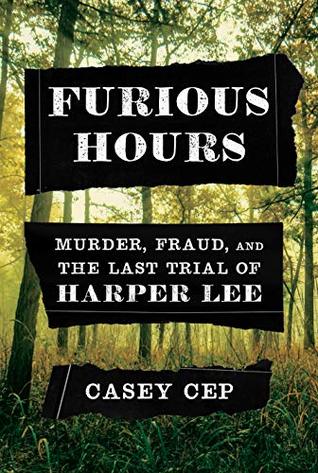
Furious Hours: Murder, Fraud, and the Last Trial of Harper Lee by Casey Cep

During the 1970s, To Kill a Mockingbird author Harper Lee devoted several years of research, writing, and editing to a convoluted real-life legal drama in her native Alabama. Given that the literary icon had served a key role in the legwork for her childhood pal Truman Capote’s true crime blockbuster In Cold Bloodit seemed like a natural fit for Lee to turn to the genre for her long-awaited sophomore book release.

Yet, the in-process title never made its way to the reading public. Cep offers a compelling biography of the notoriously publicity-shy Lee, who passed away in 2016 following the controversial publication of her long-hidden Mockingbird prequel/sequel Go Set a Watchman. She also tells the story that Lee had undertaken involving Reverend Willie Maxwell, a charismatic figure implicated in the deaths of as many as five family members in whose name he had taken out lucrative life insurance policies.

Though Maxwell had found a following as a Christian man of the cloth, rumors attributed his schemes to voodoo rituals. He managed to elude conviction thanks to legal representation provided by colorful defense lawyer Tom Radney. In an odd twist of fate, after a man named Robert Burns shot Maxwell to death at the funeral of his the Reverend’s stepdaughter, Radney filled the role of Burns’ attorney.

As someone fascinated by Lee and her talent, I wish that I could read her account of the people and events tied to the same landscapes that figured into her classic fictional tale. Yet, Cep’s narrative never fails to mesmerize in its own right.  I loved the evocative character depictions and edge-of-your-seat real-life storytelling.

Shortest Way Home: One Mayor’s Challenge and a Model for America’s Future by Pete Buttigieg

Okay, I confess to being a bit of a political nerd. Even though I wound up in the business world, my undergraduate major was political science, and I did graduate work in public administration. Add in the fact that I am an openly gay man with mostly center-left politics who is happily married and lives what could be described as as rather tranquil life of homosexual domesticity, and I guess it’s not too much of a shock that the memoir from South Bend, Indiana Mayor and 2020 Democratic presidential candidate Buttigieg held instant appeal for me.

I am a member of Generation X, while Buttigieg is a Millennial, so I must confess there is a little bit of a nagging contrarian voice inside me worrying that it would seem strange to have a national leader 15 years my junior. Yet, that bit of doubt pales in comparison to how impressed I am with “Mayor Pete’s” diverse set of credentials: Ivy League scholar, military veteran, proven leadership as an elected official in the Rust Belt region that the Democratic Party desperately needs to recapture to win back the White House.

Why would a small-city mayor bypass the usual route of first winning a statewide elected position before pursuing the Oval Office? Buttigieg’s narrative traces the unusual and unlikely circumstances of his rise to political prominence. In the aftermath of Trump’s 2016 victory, many observers speculated that the Democratic Party needed an infusion of youth and also someone who could bridge the growing gap between progressive/liberal activists and more traditional voters in America’s Heartland. So, Buttigieg’s mix of the traditional and the not-so traditional began to generate national attention.

Buttigieg provides an engaging conversational style as he continually shifts between the life of experiences in his formative years and his current political journey. His candid account of the long inner turmoil of suppressing his sexual orientation until his early thirties and then having to play catch-up in the realms of dating and relationships rang especially true for me.  Whether or not one agrees with Mayor Pete on the issues, the earnest and unassuming nature of his persona shines through.

Britt-Marie Was Here by Fredrik Backman

Swedish author Backman first gained international acclaim for his runaway bestseller A Man Called OveWhen I recently read his novel My Grandmother Asked Me to Tell You She’s Sorry, I managed to fall in love with an especially memorable supporting character named Britt-Marie; she fascinated me at every turn. So, I was delighted to find out that Britt-Marie was at the center of another Backman title.

Perhaps if sixtyish Britt-Marie had been part of a more contemporary generation, she would have been labeled as experiencing obsessive-compulsive disorder or maybe a gap in social skills tied to the high-functioning end of the autism spectrum. As a dedicated homemaker married to a workaholic financier named Kent, Britt-Marie channels her personality into keeping their apartment perfectly organized and the building’s resident association faithful to the fine points of every bylaw.

When Britt Marie learns of Kent’s flagrant adultery, she finds herself alone for the first time in her life. She lands an unlikely temporary position as the caretaker of the community recreation center in an economically-disadvantaged town on the verge of extinction. Having always viewed sports–and recreation in general–as a waste of time and attention, Britt-Marie must eat her words and become coach of the local youth soccer team.

On the surface, the plot may not seem like anything groundbreaking. It may even sound like a Lifetime or Hallmark Channel movie formula. Yet, what makes this book so amazing is the character development nicely matched with the distinct sense of place. I was mesmerized by the the charm and eccentricities on display in the humble village of lovable misfits. One of the most memorable relationships centers on Britt Marie’s odd bonding with the center’s resident rat, as a need for companionship trumps her longstanding reputation for household hygiene. As ridiculous as it sounds, somehow it all clicks for me when Backman ties things together.

Highlighting My Four Favorite Nonfiction Books of All Time

Midnight in the Garden of Good and EvilIn last month’s blog post, (you may start to notice a familiar pattern of my entries falling on the last days of the calendar months in an odd mix of procrastination and OCD)  I helped prepare for summer reading by revealing my five favorite novels of all time. Now it’s time to tackle nonfiction. For some strange reason, I am stuck on four rather than five; it is what it is.

As with last month’s selections, there is not necessarily an order overall, except for the fact that the first title on the list does happen to be my favorite book (regardless of genre) of all time. So, I guess I am kind of fuzzy on rules here, but it’s my blog. These are real-life stories that offer a memorable combination of the style of writing, the themes, or the people presented. Yes, it’s all subjective, but here goes….

Midnight in the Garden of Good and Evil: A Savannah Story by John Berendt

Midnight chronicles the protracted series of events surrounding the murder case against prominent Savannah antiques dealer Jim Williams for the shooting death of Danny Hansford, a young male escort with a long list of prominent clients (and would-be-clients) among the historic city’s elite circles. In a style that draws comparisons to literary giants Truman Capote and Norman Mailer, Berendt brings vivid attention to characters and setting to recount his time spent alongside Williams and a host of other Savannah residents.

As a devotee to the book, what stands out as I remember first devouring its pages back in the late nineties, is that the mysterious, eccentric, and charming city of Savannah itself takes center stage as the leading character. From the well-mannered precision of the Married Women’s Card Club to the banter of customers at the lunch counter of Clary’s Drug Store to the macabre beauty of Bonaventure Cemetery, the sense of place becomes palpable in a manner that transfixes the reading experience.

All Over But the Shoutin by Rick Bragg

Pulitzer Prize-winning journalist and author Bragg has drawn on his hardscrabble childhood in the Piedmont region of Alabama and his colorful family in multiple books, but if you want the best introduction to Bragg’s impressive body of work, start with this title recounting the gritty resilience of his resourceful mother and the emotionally haunted life journey of his father.

Southern storytelling seems to vacillate between extremes, where the fortunate get to embellish their tales of rich tradition and the not-so-fortunate become shocking caricatures to be pitied but not presented as possessing culture, ideals, hopes, and dreams. Bragg doesn’t sugarcoat the rough edges, but he never loses sight of the human dignity at the heart of his subjects. As an added bonus, if you listen to audiobooks, he is a fabulous narrator of his own material.

The Glass Castle by Jeannette Walls

Speaking of resilience, Jeannette Walls, who first made  a name for herself as a celebrity gossip columnist for New York  and Esquire magazines and MSNBC, chronicles a less than glamorous upbringing in her powerful autobiography. Though her parents both possessed considerable intellect and talent, through a combination of eccentricity and/or mental illness (a distinction perhaps open to interpretation), they raised their children off the grid in a vagabond existence.

As with Bragg, Walls challenges her readers to dig more deeply into the souls of the down-and-out, beyond the maudlin. The 2017  movie adaptation featured terrific performances from a top-notch cast, but I still think that the nuances of someone coming into peace and acceptance with the sordid and dysfunctional don’t quite play out as smoothly on the big screen as in print. I still recommend the film, but it’s no substitute for savoring the pages of this great book.

The Tender Bar by J.R. Moehringer

Speaking of dysfunction, how about a child raised in a pub? Well, that would be a bit of an exaggeration, but J.R. Moehringer hails from the Western Long Island community of Manhasset, New York. Manhasset holds a distinction for its rather high per-capita presence of liquor establishments and also its proximity to the real-life locales that inspired the gin-soaked antics of Fitzgerald’s Great Gatsby.

Raised by a single mother, Moehringer turned to the community around him for father figures. This included the men at a local watering hole. He also found purpose in his part-time job at the town’s branch of a bookstore chain where the staff managed the store and its inventory in a rather unorthodox fashion. The vivid descriptions of time and place manage to create something special here, even when the coming-of-age details seem pretty conventional at face value .

I realize that these picks probably slant heavily in the direction of my taste for the quirky. Yet, I would still make a pitch for any of them as solid choices for a great reading experience. Oh, and by the way, I just now thought of a possible number five, Frank McCourt’s Angela’s Ashes, but I will leave that as a last-minute aside rather than a full-fledged listing.

Keep cool everyone!

Highlighting My Five Favorite Novels of All Time

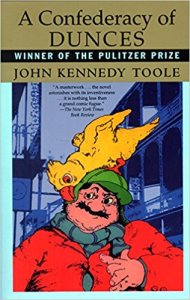
Confederacy of DuncesYesterday marked the kickoff of BookExpo America in New York, the annual event bringing together all facets of the American publishing industry into one place. Also, PBS has launched the Great American Read initiative, with voting to last through the summer. So, it seems like a fitting time to share my own reading favorites.

I figured that I would start with fiction. I plan to follow up with a post devoted to non-fiction picks in the near future. So, for now, here are my top five novels in no particular order. I guess my criteria entails books that resonated with me for some reason, a combination of the style of writing, the themes, or the characters. It’s all subjective, but here goes….

A Confederacy of Dunces  by John Kennedy Toole

Toole’s novel, published posthumously 11 years after the author committed suicide, captured the Pulitzer Prize for fiction in 1981. His mother had discovered the smeared manuscript among his possessions and undertook a long journey toward bringing her son’s creation to the literary world.

The darkly comic plot details the bizarre adventures of eccentric New Orleans resident Ignatius J. Reilly. Ignatius lacks the most basic of social graces and views contemporary society through a lens of mockery and disdain. He possesses an obsession with the elitist ideals of the Middle Ages. He is a man of extreme appetites and the most archaic of creative pursuits.

The storyline plays quite effectively against the backdrop of the Big Easy with all of its quirky charm. Toole creates a host of colorful  supporting characters just  as memorable as Ignatius. If you have a taste for sardonic wit and misfit perspectives, I highly recommend this modern classic.

A Prayer for Owen Meany by John Irving

Irving often gives rise to comparisons with Charles Dickens, and I agree with that assessment. His narratives take on a sweeping historical scope. Owen Meany may be familiar to movie fans as the inspiration for the 1998 film Simon Bircha good flick to be sure, but  one that zeroes in on a narrow and compressed portion of the novel’s complex timeline.

Yes, the book traces the  life experiences of a man remarkable for his short stature. Yet, Owen takes on so much more than his distinctive physical characteristics. Blessed with winsome charisma, he becomes a courageous everyman  for his generation during the upheaval of the 1960s and Vietnam War era.  Through the eyes of the narrator–his best friend John Wheelwright–the character of Owen takes up residence in my head, and that’s a good thing.

Beach Music by Pat Conroy

One of my favorite authors, perhaps my very favorite if someone were to force me to choose, the late Pat Conroy had a unique gift for painting mental pictures of time and place, particularly as it relates to the Low Country region of South Carolina, with his beautiful prose. And, he gave birth to characters that seem to come to life on the page.

Beach Music weaves together a rich tale of  resilience and reinvention in the face of heartache and family dysfunction. A widower comes to terms with the secrets of his late wife’s parents and his own mother and father. The book within a book approach delivers a powerful catharsis, and it’s the sort of read that leaves a lasting emotional imprint.

The Hour I First Believed by Wally Lamb

Also effectively utilizing the book within a book device, the novel masterfully connects divergent threads related to the staff and inmates at a women’s prison in Lamb’s native Connecticut with the horrific events of the 1999 Columbine shootings in Colorado. Yes, this represents a risky move, but Lamb is the consummate storyteller. There is the well-know metaphor of “the butterfly effect,” where the little seemingly random details of life and the universe usher in dramatic consequences; Lamb’s tale evokes that kind of experience.

The Great Gatsby by F. Scott Fitzgerald

Okay, I have to put at least one of the classics from my high school and college reading assignments on the list. I remember this novel as the first time that serious fiction I had to read for class became something in which I truly took pleasure. I guess what made such a powerful impression on me was Fitzgerald’s knack for presenting point-of-view, especially in regard to the title character Jay Gatsby.

The depiction of a self-made man feeling alone in the crowds at his own parties at his own colossal home managed to stick with me. Jay Gatsby remained a stranger in his own life, to borrow a phrase from Cheryl Crow. For Fitzgerald, this predicament was tied to the excesses of the Roaring Twenties era in which he wrote his masterpiece, but I think this theme speaks to the larger human condition.

There you have it. I am not claiming to provide a definitive list here, just a snapshot of a few books that I haven’t quite managed to get over, and I mean that in a positive sense. Happy summer reading.