
Memorial Day typically marks the unofficial start to summertime, though here in Nashville it seems we’ve had nonstop toasty weather since Easter. At any rate, I wanted to highlight three titles that have recently caught my fancy. Two of them are new nonfiction releases, while another–a novel–is actually a couple of years old but took a while for me to discover.
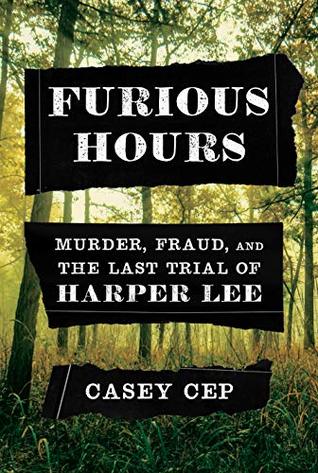
Furious Hours: Murder, Fraud, and the Last Trial of Harper Lee by Casey Cep
During the 1970s, To Kill a Mockingbird author Harper Lee devoted several years of research, writing, and editing to a convoluted real-life legal drama in her native Alabama. Given that the literary icon had served a key role in the legwork for her childhood pal Truman Capote’s true crime blockbuster In Cold Blood, it seemed like a natural fit for Lee to turn to the genre for her long-awaited sophomore book release.
Yet, the in-process title never made its way to the reading public. Cep offers a compelling biography of the notoriously publicity-shy Lee, who passed away in 2016 following the controversial publication of her long-hidden Mockingbird prequel/sequel Go Set a Watchman. She also tells the story that Lee had undertaken involving Reverend Willie Maxwell, a charismatic figure implicated in the deaths of as many as five family members in whose name he had taken out lucrative life insurance policies.
Though Maxwell had found a following as a Christian man of the cloth, rumors attributed his schemes to voodoo rituals. He managed to elude conviction thanks to legal representation provided by colorful defense lawyer Tom Radney. In an odd twist of fate, after a man named Robert Burns shot Maxwell to death at the funeral of his the Reverend’s stepdaughter, Radney filled the role of Burns’ attorney.
As someone fascinated by Lee and her talent, I wish that I could read her account of the people and events tied to the same landscapes that figured into her classic fictional tale. Yet, Cep’s narrative never fails to mesmerize in its own right. I loved the evocative character depictions and edge-of-your-seat real-life storytelling.
Shortest Way Home: One Mayor’s Challenge and a Model for America’s Future by Pete Buttigieg
Okay, I confess to being a bit of a political nerd. Even though I wound up in the business world, my undergraduate major was political science, and I did graduate work in public administration. Add in the fact that I am an openly gay man with mostly center-left politics who is happily married and lives what could be described as as rather tranquil life of homosexual domesticity, and I guess it’s not too much of a shock that the memoir from South Bend, Indiana Mayor and 2020 Democratic presidential candidate Buttigieg held instant appeal for me.
I am a member of Generation X, while Buttigieg is a Millennial, so I must confess there is a little bit of a nagging contrarian voice inside me worrying that it would seem strange to have a national leader 15 years my junior. Yet, that bit of doubt pales in comparison to how impressed I am with “Mayor Pete’s” diverse set of credentials: Ivy League scholar, military veteran, proven leadership as an elected official in the Rust Belt region that the Democratic Party desperately needs to recapture to win back the White House.
Why would a small-city mayor bypass the usual route of first winning a statewide elected position before pursuing the Oval Office? Buttigieg’s narrative traces the unusual and unlikely circumstances of his rise to political prominence. In the aftermath of Trump’s 2016 victory, many observers speculated that the Democratic Party needed an infusion of youth and also someone who could bridge the growing gap between progressive/liberal activists and more traditional voters in America’s Heartland. So, Buttigieg’s mix of the traditional and the not-so traditional began to generate national attention.
Buttigieg provides an engaging conversational style as he continually shifts between the life of experiences in his formative years and his current political journey. His candid account of the long inner turmoil of suppressing his sexual orientation until his early thirties and then having to play catch-up in the realms of dating and relationships rang especially true for me. Whether or not one agrees with Mayor Pete on the issues, the earnest and unassuming nature of his persona shines through.
Britt-Marie Was Here by Fredrik Backman
Swedish author Backman first gained international acclaim for his runaway bestseller A Man Called Ove. When I recently read his novel My Grandmother Asked Me to Tell You She’s Sorry, I managed to fall in love with an especially memorable supporting character named Britt-Marie; she fascinated me at every turn. So, I was delighted to find out that Britt-Marie was at the center of another Backman title.
Perhaps if sixtyish Britt-Marie had been part of a more contemporary generation, she would have been labeled as experiencing obsessive-compulsive disorder or maybe a gap in social skills tied to the high-functioning end of the autism spectrum. As a dedicated homemaker married to a workaholic financier named Kent, Britt-Marie channels her personality into keeping their apartment perfectly organized and the building’s resident association faithful to the fine points of every bylaw.
When Britt Marie learns of Kent’s flagrant adultery, she finds herself alone for the first time in her life. She lands an unlikely temporary position as the caretaker of the community recreation center in an economically-disadvantaged town on the verge of extinction. Having always viewed sports–and recreation in general–as a waste of time and attention, Britt-Marie must eat her words and become coach of the local youth soccer team.
On the surface, the plot may not seem like anything groundbreaking. It may even sound like a Lifetime or Hallmark Channel movie formula. Yet, what makes this book so amazing is the character development nicely matched with the distinct sense of place. I was mesmerized by the the charm and eccentricities on display in the humble village of lovable misfits. One of the most memorable relationships centers on Britt Marie’s odd bonding with the center’s resident rat, as a need for companionship trumps her longstanding reputation for household hygiene. As ridiculous as it sounds, somehow it all clicks for me when Backman ties things together.
 Coloring Outside the Lines