
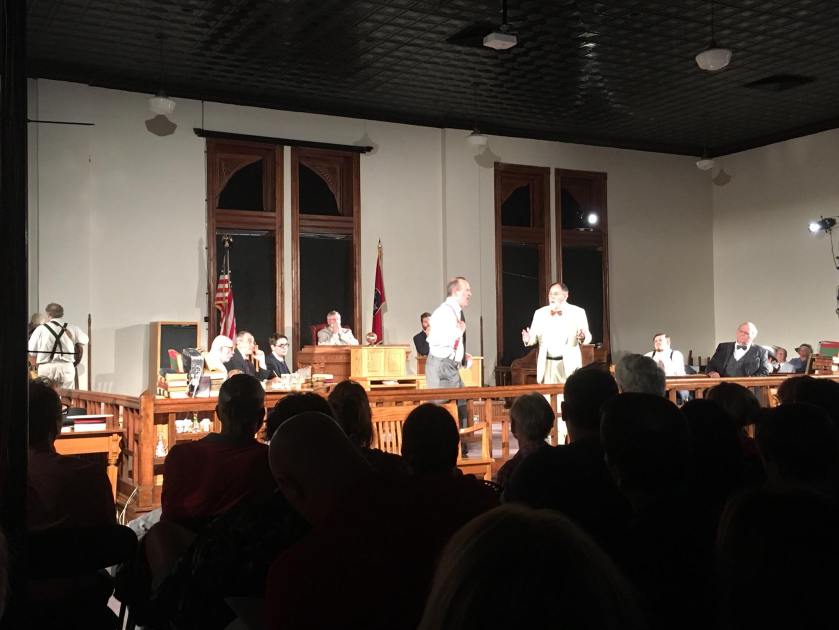
Sometimes, the places that are relatively close to where we live are the destinations that we say we want to visit when we “get around to it.” As shared in previous blog entries, my other half and I reside in Nashville. There are a wide array of day trips and weekend getaways in our neck of the woods. One of these–about a two and a half hours away from us–is Dayton, TN. A couple of months ago, we made it there for the first time.
In the hot and sticky July of 1925, Dayton became the center of the media universe as site of the Scopes Monkey Trial. The proceedings happened to coincide with the earliest incarnations of national live news broadcasts by the rapidly growing medium of radio. Print journalists from major outlets across the country also made their way to the small mountain community roughly forty miles from Chattanooga.
The trial came about through a curious mixture of small-town tourist promotion with a desire on the part of both supporters and foes to test the heretofore unenforced Tennessee state law known as the Butler Act, which forbade the teaching of any scientific theory denying the biblical account of creation (For a pretty decent timeline and synopsis of these events, check out a 2005 NPR item done in conjunction with the trial’s 80th anniversary. While much has been published about the proceedings and their aftermath, for a thorough book-length examination, I can personally vouch for Edward J. Larson’s Summer for the Gods.)
I have always maintained a deep fascination with the Scopes trial for a host of reasons. First, it marked a major turning point in the national dialogue concerning faith and science and the compatibility between the two. Also, the conflict established fault lines between the power of national religious identity and the rise of secularism. In a related twist, among Christian believers themselves, the split between evangelical/fundamentalist perspectives and more theologically liberal voices became more pronounced.
On a broader level, I think the “Roaring Twenties” holds a fair number of parallels with today. America was grappling with changing social mores and the rise of modernity in national life. Also, immigration and urbanization had left wide swaths of the South and Heartland shaken by the changing face of America. Both then and now, trends can sow the seeds for countertrends.
Like many other folks, part of my interest in the Scopes case was fueled by watching the 1960 film Inherit the Wind, a fictional story based on the real-life events of the Scopes trial. Spencer Tracy is one of my all-time favorite actors, and he shines in the character inspired by high-powered defense attorney Clarence Darrow. Likewise, Gene Kelly delivers an excellent portrayal of the equivalent to acerbic newspaper columnist H.L. Menken. And, I can’t leave out Fredric March for his turn as the figure modeled after fiery populist national political leader and religious crusader William Jennings Bryan.
Yet, as much as I adore the experience of watching the movie and appreciate the light it sheds on the debate about faith and science, some fine points bug me a bit. The film features Dick York–future Darrin #1 on Bewitched–in the role of the young teacher on trial for teaching evolution; he sits in a jail cell during the trial, an object of scorn and ridicule. In actuality, Scopes was never jailed, and punishment for violating the law was a 100 dollar fine. While the national political and cultural implications were indeed serious, the local origins of the case were more along the lines of a publicity stunt than a vendetta against Scopes.
At any rate, the trial came and went, and Scopes was found guilty as charged, though the conviction was later overturned on a technicality, and the Butler Act was repealed in 1967. In terms of the over-arching conflict, secularism and modernity carried the day in much of the wider culture and the media. Fundamentalism retreated to begin building up its own self-contained institutions, including a prominent college built in Dayton and named after Bryan, who died suddenly while still in the town a mere five days after the trial’s conclusion. Decades later, similar conflicts would again play out on the national political stage and reshape the partisan political landscape.


Strangely enough, the tourism angle of the Scopes Monkey Trial took several decades to come to fruition. In the 1970s, a major renovation project restored the Rhea County Courthouse to its original glory, and a museum devoted to the trial (remodeled in 2018) was added to the basement. In the 1980s, the annual Scopes Festival began as an opportunity for the community to commemorate the event that put it on the map.
The timing of the festival coincides with the anniversary of the trial itself. In addition to such staples as food and bluegrass music, the festival now includes the highly entertaining play Front Page News, a re-enactment of the events surrounding the trial. As an added bonus, the drama plays out in the very courtroom where the actual trial happened.
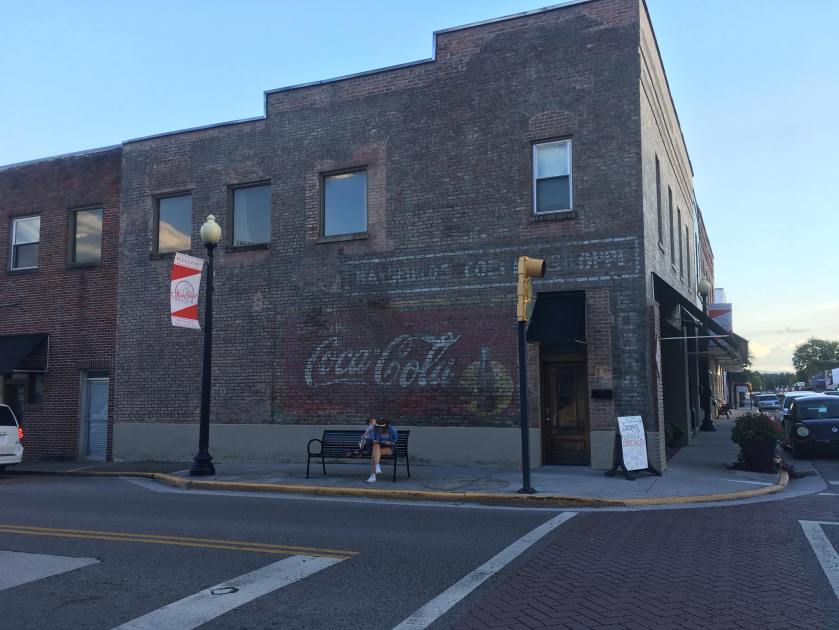

The museum takes about an hour to tour, and it would be important to double-check on the open time and dates if making the trip to Dayton. We had a nice lunch at the Monkey Town Brewery and then sampled some of the excellent music on the courthouse lawn before and after the matinée of the play. It could have easily been a day trip for us, but we stretched things out by spending the night.
No, it wasn’t necessarily one of those action-packed getaways, but it was so enjoyable and enlightening to connect with a unique bit of history in the state where we live. If you are visiting Chattanooga and have a bit of time to spare to make it over to Dayton, I think the museum is worth checking out in its own right. And, if you can make it to the Scopes Festival and the play when July comes around, even better.
 Coloring Outside the Lines