
 Yesterday marked the kickoff of BookExpo America in New York, the annual event bringing together all facets of the American publishing industry into one place. Also, PBS has launched the Great American Read initiative, with voting to last through the summer. So, it seems like a fitting time to share my own reading favorites.
I figured that I would start with fiction. I plan to follow up with a post devoted to non-fiction picks in the near future. So, for now, here are my top five novels in no particular order. I guess my criteria entails books that resonated with me for some reason, a combination of the style of writing, the themes, or the characters. It’s all subjective, but here goes….
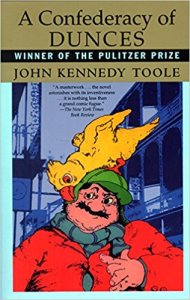
A Confederacy of Dunces by John Kennedy Toole
Toole’s novel, published posthumously 11 years after the author committed suicide, captured the Pulitzer Prize for fiction in 1981. His mother had discovered the smeared manuscript among his possessions and undertook a long journey toward bringing her son’s creation to the literary world.
The darkly comic plot details the bizarre adventures of eccentric New Orleans resident Ignatius J. Reilly. Ignatius lacks the most basic of social graces and views contemporary society through a lens of mockery and disdain. He possesses an obsession with the elitist ideals of the Middle Ages. He is a man of extreme appetites and the most archaic of creative pursuits.
The storyline plays quite effectively against the backdrop of the Big Easy with all of its quirky charm. Toole creates a host of colorful supporting characters just as memorable as Ignatius. If you have a taste for sardonic wit and misfit perspectives, I highly recommend this modern classic.
A Prayer for Owen Meany by John Irving
Irving often gives rise to comparisons with Charles Dickens, and I agree with that assessment. His narratives take on a sweeping historical scope. Owen Meany may be familiar to movie fans as the inspiration for the 1998 film Simon Birch, a good flick to be sure, but one that zeroes in on a narrow and compressed portion of the novel’s complex timeline.
Yes, the book traces the life experiences of a man remarkable for his short stature. Yet, Owen takes on so much more than his distinctive physical characteristics. Blessed with winsome charisma, he becomes a courageous everyman for his generation during the upheaval of the 1960s and Vietnam War era. Through the eyes of the narrator–his best friend John Wheelwright–the character of Owen takes up residence in my head, and that’s a good thing.
Beach Music by Pat Conroy
One of my favorite authors, perhaps my very favorite if someone were to force me to choose, the late Pat Conroy had a unique gift for painting mental pictures of time and place, particularly as it relates to the Low Country region of South Carolina, with his beautiful prose. And, he gave birth to characters that seem to come to life on the page.
Beach Music weaves together a rich tale of resilience and reinvention in the face of heartache and family dysfunction. A widower comes to terms with the secrets of his late wife’s parents and his own mother and father. The book within a book approach delivers a powerful catharsis, and it’s the sort of read that leaves a lasting emotional imprint.
The Hour I First Believed by Wally Lamb
Also effectively utilizing the book within a book device, the novel masterfully connects divergent threads related to the staff and inmates at a women’s prison in Lamb’s native Connecticut with the horrific events of the 1999 Columbine shootings in Colorado. Yes, this represents a risky move, but Lamb is the consummate storyteller. There is the well-know metaphor of “the butterfly effect,” where the little seemingly random details of life and the universe usher in dramatic consequences; Lamb’s tale evokes that kind of experience.
The Great Gatsby by F. Scott Fitzgerald
Okay, I have to put at least one of the classics from my high school and college reading assignments on the list. I remember this novel as the first time that serious fiction I had to read for class became something in which I truly took pleasure. I guess what made such a powerful impression on me was Fitzgerald’s knack for presenting point-of-view, especially in regard to the title character Jay Gatsby.
The depiction of a self-made man feeling alone in the crowds at his own parties at his own colossal home managed to stick with me. Jay Gatsby remained a stranger in his own life, to borrow a phrase from Cheryl Crow. For Fitzgerald, this predicament was tied to the excesses of the Roaring Twenties era in which he wrote his masterpiece, but I think this theme speaks to the larger human condition.
There you have it. I am not claiming to provide a definitive list here, just a snapshot of a few books that I haven’t quite managed to get over, and I mean that in a positive sense. Happy summer reading.
 Coloring Outside the Lines
One thought on “Highlighting My Five Favorite Novels of All Time”