
As of today, I have seen seven of the nine Best Picture Oscar® Nominees. So far, I haven’t disliked any of them, but
Moonlight, turned about to be the one that held me under a spell when I saw it three weeks ago. I really enjoyed the artistry of LaLa Land and don’t begrudge that film’s acclaim. Yet, my take on the musical was that it is the sort of thing that Hollywood is predisposed to honor because it’s about Hollywood. So, I began preparing this blog Sunday afternoon with the thinking that it was going to celebrate why Moonlight should have won Best Picture.
Well, it ended up being a strange night. La La Land dominated much of the evening, and thanks to an unprecedented envelope glitch, was revealed as the winner of the top prize at the close of the ceremony. Yet, in a bizarre twist, the victory speeches were interrupted with the news that an upset had indeed happened. So, the outsider contender that I and several others were championing overcame the odds.
So, why did I Iove this little movie so much? I guess for me Moonlight is one of those pieces of cinema that inhabits my head in the hours and days after I walk out of the darkened auditorium. The characters haunt me, and somehow I think about things a bit differently for having inhabited their world.
Based on a semi-autobiographical stage work by playwright Tarell Alvin McCraney, Moonlight traces the heart-wrenching coming of age journey faced by a youth named Chiron in Miami’s Liberty City neighborhood. Director Barry Jenkins co-wrote the film’s screenplay with McCraney, and the two men fused together aspects of their own childhoods.
Jenkins and McCraney came to the project with many common perspectives, though Jenkins is straight and McCraney had written the play from his formative experiences as a gay man. So, the two penned Chiron as a boy–and later a young man–who must face the double whammy of growing up amidst poverty, addiction, and violence and also coming to terms with being “different from other boys” on streets where machismo is a matter of life and death.
I will do my best to set the scene without revealing spoilers, as I do hope that more folks give Moonlight a try, whether on DVD (starting Tuesday February 28th) or in the theaters where it’s still playing. The Miami setting plays a large part in the film’s motif. Like many tourists, I have experienced the glitzy side of South Florida and its famous beaches, though the Liberty City neighborhood presents a very non-glamorous setting, but the ocean breezes and sandy beaches still manage to mesmerize.
Chriron’s mother Paula, played brilliantly by Oscar nominee Naomi Harris, wantonly neglects her son, caught up in crack cocaine and a host of related destructive behaviors. Chiron often finds himself either home alone or–perhaps even worse–stuck in the apartment with his mother when she is either coming down from her latest fix or desperately seeking her next.
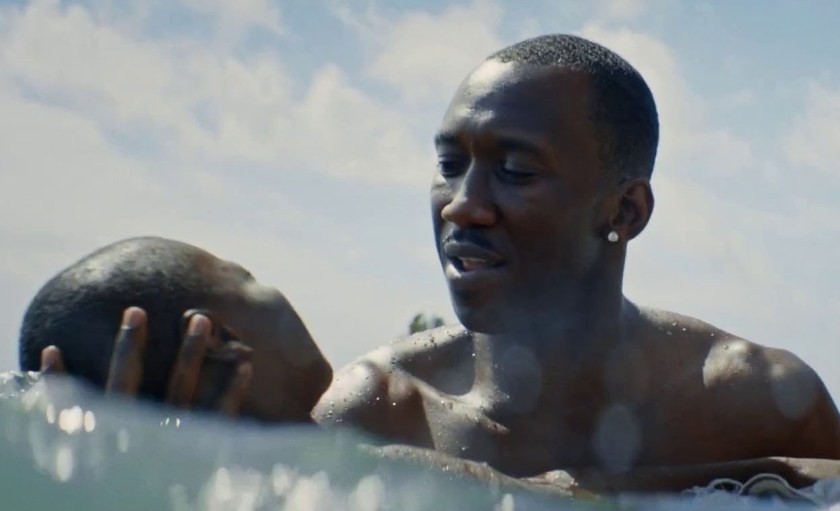
The vulnerable young Chiron meets a strong and kind adult-male role model named Juan, played to absolute perfection by Oscar winner Mahershala Ali. Juan and his girlfriend Teresa have a warm and comfortable home where food is always on the stove and love is unconditional. Chiron finds a special safe place to spend his nights and weekends.
Juan and Teresa would qualify as a surrogate mom and dad figures straight out of Norman Rockwell Americana, complete with swimming lessons and other rites of boyhood. Yet, in an ironic twist, Juan’s middle-class lifestyle comes from his work as the very drug-dealer from whom Paula purchases her crack.
This contradiction makes me think of a couple of different classic Dickens novel, where the criminal figure is somehow the one doing the mentoring and/or material support of boys when there is no one else on the scene. And, Juan has many noble characteristics. He is one hell of a nice guy, really. His stance of rationalization/justification almost seems convincing, almost. Yet, when one steps back and sees the legacy of crack, those warm fuzzies grow a bit cold.
The action picks back up when a teenage Chiron finds himself less and less able to “pass” in the presence of his peers. With his friend Kevin, he experiences the bliss of a same-sex romantic encounter and the pain of betrayal. The remaining events take shape in a roller coaster ride of emotions.
I was raised in a white middle-class background in the rural South. So, I can’t relate to Chiron’s experiences related to urban crime and poverty. Yet, as a gay man who spent my formative years trying to suppress and deny who I really was, the experiences of Chiron and his complicated relationship with Kevin hit rather close to home.
Sadly, gay boys–and gay men–have a track record for turning on each other when internalized homophobia and the pressure to conform to the wider society dominate. So, sometimes the result can be that those very individuals struggling with their own thoughts and feelings end up being at the heart of bullying behaviors.
I realize that this is by no means a novel concept among story lines tackling gay issues, the “thou dost protest too much” character stuck in the closet. Moonlight moves beyond the movie-of-the week clichés and sermonizing of past offerings and strips things down into something refreshingly raw. More than any other movie about gay issues, Moonlight made me think about internalized homophobia that I had witnessed in my own life experiences, not necessarily violent in nature, but stinging nonetheless.
Moonlight is not a movie designed to appeal just to gay people. I think it’s a pretty universal story about acceptance and reconciliation. Yet, at the same time, I admire the fact that the film didn’t try to water down the sheer weight of gay identity at the center of Chiron’s struggle either. And ultimately, what makes it such an unforgettable film for me was how painstakingly real the characters become, which I think speaks to the top-notch work on both sides of the camera.
 Coloring Outside the Lines