
Netflix streaming can become pretty addictive. My other half and I enjoy vegging together to binge on the various options from time to time. Yet, there are a couple of complications. First, he recently undertook a mid-life career transition to become a registered nurse and now works 12-hour night shifts, so figuring out how to reconcile our two schedules can present a challenge. Secondly, our tastes—while in sync with regard to quite a bit of the good stuff that’s out there like Orange is the New Black–seem to diverge due to the fact that horror, fantasy, and science fiction really float his boat, while I generally find myself drawn to subject matter that seems more directly related to concrete life experiences or current social issues.
Don’t get me wrong, I consider myself highly creative and imaginative; it’s just that I possess the type of imagination that connects storytelling to the here and now, the things that I think could happen to me or to someone I know. There is a perfect genre at which we can meet in the middle, stories that classify as psychological thrillers/suspense. Sometimes, there can even be science-fiction style plots that veer into this territory.
Rod Serling’s Twilight Zone stands as the perfect representation of such entertainment. No, neither of us is quite old enough to have watched the original series in prime time, but we were certainly immersed in the syndicated reruns that served as a staple for late-night television in the eighties. With his eerie demeanor and unrepentant on-air cigarette habit, creator/narrator Serling introduced us to an alien time and place that always managed to provoke questions about moral, social, and political matters. Recently, based on both the pleas of my beloved and a “you might like this” marketing e-mail from Netflix (I won’t say which was more persuasive.), I watched two episodes of the newly released third season of Black Mirror. This series, begun in Great Britain but brought to North America thanks to the deep pockets of Netflix, offers a 21st Century take on the Twilight Zone experience, where the heavy-duty issues focus specifically on technology.
Right off the bat, one liberating aspect of Black Mirror that serves our household especially well at the moment is that, like Twilight Zone, the program presents each episode in a completely self-contained fashion. So, no worries about viewing things sequentially or skipping ahead to reveal spoilers. Somehow, this just seems simpler to deal with, and I hope to see this become a trend in television land, but I digress.
I have only seen two episodes so far, so I can’t claim to be a Black Mirror expert. So far, I am highly impressed with what I see. Yet, I am not a television critic, and the purpose of my blog doesn’t really directly relate to rating or reviewing programs. Rather, my sampling of Black Mirror has prompted me to do a great deal of thinking even to the point of overcoming writer’s block and posting this blog entry.
As mentioned in previous blog entries, I work in the field of marketing technology. Yet, I am just one year shy of the half-century mark, so as a Gen X member, I feel that I stand at a crossroads where I am young enough to be a player in the game but old enough to detach myself a bit. As I have said before, if the digital age ended tomorrow through some apocalyptic catastrophe, I think I would be okay. I spend a fair amount of time weighing the various pros and cons and hoping to reconcile it all. Therefore, the Black Mirror plots–so far at least–seem like crack cocaine for someone like me.
The first episode I watched centered on an alternative future society where all residents possess special microchip recorders surgically wired to their eyes and brain to record every moment of each day. Not surprisingly, the device proves itself a two-edged sword. Friends and family members replay their shining achievements to earn bragging rights and also offer feedback that may not always prove constructive. Of course, sex and relationships, get rather complicated as well, not exactly an original idea for fans of the film Eternal Sunshine of the Spotless Mind but compelling nonetheless.
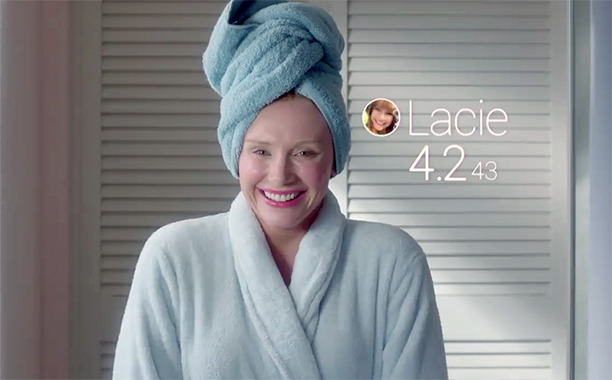
The next episode I got to see really hooked me in though. In this fictional universe that seems eerily close to the new reality, each citizen possesses an account tied to mobile and social technology where others continuously rate them on scores of one to five. Friends, colleagues, strangers on the sidewalk and in a busy airport concourse can vote up or down based on social encounters big and small or all sorts of prejudices. The scores have impacts on where someone can live, work, or travel. It’s a two-way street in that both sides of every encounter possess the power to rate one another, not unlike the real-life customer rating dynamic of the ride-sharing service Uber recently explored by Time columnist Joel Stein in an enlightening piece.
So, I think I am probably going to like Black Mirror. It’s certainly entertaining television, but more importantly, I think this line of questioning really clicks for me. I don’t think it’s a matter of saying that our ever-smarter gadgets are an evil force in their very essence. Yet, I think it’s just a matter of knowing when to step back and develop some perspective and maybe dial it down a notch. There are so many facets of how this struggle can take shape. I may explore them in greater depth as part of future posts, but in the meantime, if you have a Netflix streaming subscription and you like pondering this kind of stuff, you should give Black Mirror a try.
 Coloring Outside the Lines
Like you I only just learned about Black Mirror. I heard the third season had just been added to Netflix and when it was compared to The Twilight Zone I yelled, “How have I not heard of this before?”
While I also enjoy the ongoing series–Orange Is The New Black is a favorite and Stranger Things is both fun and nostalgic–the self-contained stories of Black Mirror are a nice change.
I binge-watched the first two seasons and half of season three which isn’t as bad as it sounds–they’re short.
And it’s a very thought-provoking series but also unrelentingly bleak. Even the happier episodes are marked by deep sadness and the first episode of season 3 was one of the few with moments of humor. Even then it was dark humor.
The Twilight Zone was often thought-provoking but wasn’t above some occasional pure fun. I hope Black Mirror will indulge too.
LikeLike