Thinking About the 48% of Tennesseans Who Don’t Want Any Legal Recognition for My Partner and Me

This is not a “gay blog” per se. My sexuality represents just one part of who I am. Yet, I don’t mind bringing that information to the table when it’s relevant to issues at hand. I struggled through my youth and young adulthood to come to terms with my identity and finally got things sorted out nicely around the age of 30. Now that I have reached my late 40’s, there’s no looking back. I value honesty, both to myself and to the world at large.

My partner and I, who have been together for five years, make our home in a blue dot (Nashville) of increasingly red Tennessee. I am grateful for our supportive families and friends and for my employer who believes providing employees in committed same-sex relationships with access to family benefits is smart business. We go to church, own a pretty generic condo in a suburbanish neighborhood,  and do the normal things like going out for Starbucks coffee and Sweet CeCe’s frozen yogurt. A wild night for us would be to drink two beers each at Pie in the Sky Pizza, our favorite neighborhood eatery.

I think we have a pretty good life, and we are blessed in so many ways. This is not a “being gay is so hard” guilt trip piece. Yes, coming of age in the Bible Belt during the 1980’s presented its share of challenges, but we both managed to arrive at a healthy place. Yet, as we anticipate (hopefully) the United States Supreme Court settling things on a national level, it seems that the Volunteer State shows signs of a renewed backlash against the value of our relationship.

According to a recent poll from our Music City’s esteemed Vanderbilt University, aka the “Harvard of the South,” support for gay marriage among Tennessee residents has actually dropped a few points over the past year. Granted, compared with the more distant past, things have improved, but the recent developments in most of the rest of the country may have hit a bit too close to home for some Tennesseans. I will let the armchair politicos among you dissect the results for yourself, but the one figure that sticks with me is that 48% of  the states residents believe that same-sex relationships do not deserve any legal recognition at all, whether it be full-fledged marriage or alternatives such as civil unions.

So, almost half of the citizens of our lovely state basically feel that my significant other and myself don’t count legally as a couple. I realize that this doesn’t mean that they hate us. Maybe it’s fear of that “slippery slope” of folks wanting to marry animals or siblings. My response is that this kind of scenario is an irrelevant distraction. As our medical, psychological, and sociological understanding of sexual identity has evolved over the past several decades, the solid consensus of mainstream scientific authorities declares being gay as a normal variation of human sexuality and efforts to change this orientation as ineffective and potentially counter-productive.

The physical aspects of homosexuality represent just one part of what it means to be gay. Those of us who are  attracted to the same gender generally hold a wide range of psychological, emotional, and romantic attachments as a part of the mix. It’s not a matter akin to switching from real to decaffeinated coffee or going from driving an automatic to a stick-shift car. It’s not a switch that gets flipped on and off but rather an identity that we do our best to try to incorporate into the many other areas of our lives.

No one has to remind my partner and me that the South is a more religiously conservative part of the country and that fundamentalist and evangelical branches of Christianity hold more sway here than in the Northeast and on the West Coast. Both of us, in our own ways, have had to reconcile our faith traditions with our sexuality. This is not an easy process, and I am not saying that I possess all the answers regarding the “God and gays” question.

In this day and age, most of the public objections to homosexuality do center on religion, and in this part of the world Christianity in particular. When folks want to engage me along the lines of an “it’s a sin because the Bible says so” line of discussion, my first inclination is to try to advocate for a more broad perspective of Christian theology and Biblical interpretation. I would love to “convert” more people to my side of that fence, and I have even put together a few links that explore the gay Christian point-of-view in case that information might be helpful for some of you. I could also get into a long discussion of how “Biblical” marriage evolved over the centuries through shifting cultural and family norms.

However, the risk I run in these exchanges is that I can sometimes fall into the trap of asking for someone’s approval in order for them to grant me my basic dignity as an individual and afford to my other half and me the right to be treated as a couple.  Someone will look at my talking points and then say, “Sorry, but no. Your view of the Bible doesn’t match with mine, so I can’t affirm gay rights in any way. No protections for you.”

Sometimes, those accommodations are termed “special rights for homosexuals,” which leaves me scratching my head. What is so “special” about my wanting to work at the job of my choosing without fear of discrimination for being gay? What is so special about me wanting to hold hands with the person I love at the movies? (Public displays of affection ought to operate under the same common-sense rules for everyone in my mind, so I am not talking about anything lewd.) What is so special about expecting the right to make health care decisions involving my partner if–God forbid–something happens where I would need to fill such a role?

As mentioned earlier, our families are wonderful toward us, so they aren’t going to do something that would undermine our relationship in any kind of spiteful way, but this sort of thing happens in cases where gay men and women aren’t blessed with affirming relatives and end up being cut out of the lives of their partners as if they didn’t exist at all.  Yes, there are various legal documents that folks have undertaken in the past to deal with these gaps, but they aren’t as comprehensive as what heterosexual married couples have always for granted. It ends up being a patchwork that is better than nothing but a “workaround” nonetheless.

So, I don’t think our treatment should be a matter of appealing to someone’s particular brand of faith. Yes, America was founded on broad principles steeped in the Western Judeo-Christian tradition, and I appreciate those. However, we were also founded on principles of democracy and the rights of the individual tied to the civic values of the ancient Greeks and Romans and the Age of Enlightenment. America is not a Christian theocracy anyway, but even if we pretended for a moment that it were, whose brand of the Christian faith would call the shots? Would it be Catholics, Pentecostals, Seventh Day Adventists, Quakers, middle of the road Methodists like yours truly, or any number of  organizations who identify with the teachings of Jesus Christ? Ultimately, a government with no religious litmus tests for its citizens helps protect the rights of people from all faith traditions (or even no religion at all) in our increasingly diverse society.

And just how would legal recognition of gay nuptials destroy the sanctity of anyone’s traditional heterosexual marriage? There is–and definitely should be–a huge distinction between government granting marriage licenses and recognizing the rights of couples and how religious bodies may–or may not–choose to bless matrimony. There are entire faiths and denominations that refuse to perform ceremonies between their members and those outside the flock.  There are also religious groups that refuse to sanction marriages where one of the parties has previously been divorced. And, moving away from the heavy-duty stuff a bit, there are individual congregations and pastors who require that couples attend pre-marital counseling or perhaps write a check to the church for a cleaning deposit before tying the knot.

Guess what? None of those practices relate to whether the court-house grants licenses to couples. It’s two entirely different questions. As it stands now, our particular denomination forbids its clergy from performing same-sex ceremonies or its church facilities from hosting these nuptials. There are voices inside working diligently to change this, and some pastors risk losing their ordination by violating this policy in the name of equality. We would love to see the rules change, but that’s a separate issue from being able to enter into marriage through a civil ceremony.

So, my partner and I don’t have a secret agenda to drape Tennessee in the rainbow flag. We just grow tired of feeling as if we have to make everyone love us, though of course we do think we are pretty lovable. We are claiming our right to live our hopes and dreams with each other, even in a state that happens to be turning as red as Elizabeth Arden’s door. In the ground-breaking 1996 film To Wong Foo Thanks for Everything, Julie Newmardrag queen Vida Boheme–played by the late Patrick Swayze–sums it up pretty nicely with the memorable quote, “Your approval is neither desired nor required, but I will take your acceptance.”

Vida Boheme

A Few Helpful Resources on The Gay Christian Experience

This is not by any means a comprehensive listing, but I think these four are a decent starting point.

http://www.matthewvines.com/the-bible-and-homosexuality-why-i-left-college-and-spent-two-years-finding-out-what-the-scriptures-re

https://www.gaychristian.net/faq.php

http://ecinc.org/clobber-passages

http://www.thegodarticle.com/faith/clobbering-biblical-gay-bashing

Savoring the Charms of Charleston, South Carolina

Charleston, South Carolina was always on my list of places that I was going to visit when I got “around to it.” Literary giant Pat Conroy, one of my favorite authors, lives  approximately 50 miles away  in the town of Beaufort but has set several of his novels in the historic Southern port city. I had also previously had the opportunity to visit Savannah, GA both as on a family trip as an child and on a grown-up vacation in search of all things Midnight in the Garden of Good and Evil

Charleston and Savannah, roughly a two-hour car ride apart, maintain a long-standing sisterly rivalry as the two principal urban centers of the geographically and culturally distinct coastal region known as the “Low Country.” I had always wanted to experience both cities to see the comparison for myself. So, this past March, my partner–who loves experiencing different cultures as much as I do– and I flew from Nashville (where we live) to Charleston for a little three-night getaway.

The verdict? I don’t think it’s really fair or necessary to rank these two wonderful communities that date back to colonial times as being “better” or “worse.” They both embody a unique sense of place and character. I could sum it up by saying that Savannah feels like the eccentric and sometimes rowdy sister who comes alive on Saturday nights, while Charleston is the poised and gracious hostess of a relaxed Sunday brunch.

Charleston’s Diverse Heritage
Charleston was first settled by the English way back in 1670, but the city’s appeal is not purely a matter of how old it is. Rather, Charleston offers a rich tapestry of cultures that make the city so remarkable. Charleston’s Historic District includes a French Quarter, but with a considerably more sedate vibe than New Orleans. The French men and women who made their way to Charleston in the late 17th Century were the Huguenots, Calvinist Protestants fleeing religious persecution in their motherland. So, the French influences seem to morph into other heritages. (Evidently the city does hold an annual Mardi Gras celebration though.)

Charleston and the surrounding locales are also strongly shaped by the Gullah people, the descendants of black slaves who developed their own language and have preserved many distinct cultural traditions from Western and Central Africa. The vast City Market complex provides an excellent opportunity to browse Gullah arts and crafts, though vendors display their handiwork on the nearby sidewalks as well.

Staying There and Getting Around
If you want to experience the essence of Charleston culture for your vacation, I suggest staying in or near the Downtown Historic District. We rested our heads at the Days Inn, which was conveniently located and unlike some locations in that chain was perfectly fine and did not have the feel of a meth lab/crack house combination.

The experience of Charleston on foot holds a delight for the senses; the sights, smells, and sounds  come together into something extra special. The different hours of the day all have their own feel to them. The nighttime glow of the gas lamps on the residential streets seems almost other-worldly. As a word of warning though, the Google Maps app for pedestrians is pretty worthless in the above-mentioned City Market area with its maze of  dead-end streets and alleys. So, if you are needing to get someplace on foot in a timely fashion, don’t be afraid to ask the locals for detailed directions; Charleston consistently ranks as one of America’s most polite cities.

To take in the lay of the land, there are many horse-drawn carriage tours of the Historic District. To venture out a little further, I would highly recommend a bus tour from Grayline. I don’t think it’s a regular part of the tour we were on, but the driver was kind enough to take us on detour through the campus of The Citadel, the military college that inspired Conroy’s novel Lords of Discipline. After the sun goes down, I strongly suggest taking a ghost tour. There are many from which to choose, but I can personally vouch for Bulldog Tours. Whether or not you are a fan of the paranormal, the local color will provide memorable evening entertainment.

Taking In the Historical Sites
I won’t pretend to deliver a comprehensive catalog of the countless attractions of interest to history lovers.  However, Fort Sumter, where the War Between the States began would certainly top such a list. I confess that I sometimes grow  weary with the whole Civil War re-enactment obsession here in the South. Yet, to walk the hallowed ground of the island where those ominous shots were fired provides a moving encounter with the past.

The Old Exchange and Provost Dungeon provides a fascinating glimpse into the era of the American Revolution. In addition to making a daytime stop at this important public building, we also experienced the dungeon portion as part of the above-mentioned ghost tour. Given the role of slavery in creating Charleston, the Old Slave Mart Museum tells a valuable story of history’s neglected voices. Yes, Charleston has some elements that present the Gone with the Wind spectacle of the Old South, but from what I can see, I think that there is at least some degree of effort to balance those images with the bigger picture.

Charleston has been deemed “the Holy City,” though that distinction is more a matter of the quantity of houses of worship than a particular bent to piety. There are so many sanctuaries of historic significance that going inside all of them may not be practical, and sometimes the hours during which the doors are open to tourists can seem a bit arbitrary. If you choose just one, make it Saint Michael’s with its  well-preserved 18th Century touches.

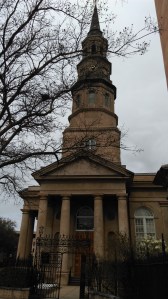
The graveyards and cemeteries associated with Charleston’s churches also provide endless intrigue. (I confess that I didn’t know the difference between a graveyard and a cemetery before my trip. I will leave it to you, dear reader, to Google it yourself if you need to.) An especially colorful series of historical events surround this distinction on the grounds of Saint Philip’s Church, which is very near the relatively small but charming structure of the French Huguenot Church. I would also be remiss if I did not mention the impressive Cathederal of Saint John the Baptist, the mother church of the region’s Roman Catholic Diocese.

A Detour to Blooming Things and Alligators
Several historic plantations on the outskirts of Charleston are open to visitors. We chose Magnolia Plantation and Gardens, which we were told was the best option for those more interested in nature and wildlife than the whole Rhett Butler/Scarlett motif. The plantation house was rebuilt after the Civil War ended, so the architecture reflects a sense of dignified restraint.

What makes Magnolia so worthwhile are the wonderful garden paths where nature truly comes alive. We were there in early March, which in the Low Country warmth marks the start of Spring, so we were truly blessed by the fragrances in out midst. One particular smell, which we later identified as the tea olive tree, permeated inside the plantation residence, so much so that I asked the guides if they were using some special type of potpourri or air-freshener. I guess it’s hard to beat Mother Nature’s gifts in that department. There are a host of specialized tours available on the property, and we opted for a boat ride through the swamp, complete with alligators.

Transportation-Related Aside: We had not rented a car for our stay, so we chose the ride-sharing service Uber for the 10-mile journey from our hotel to the Magnolia. Using Uber’s smart-phone app to book a return trip proved impossible, so along with a family of fellow Magnolia visitors  in the same predicament, we relied on an old-school taxi service to get back into the city. I don’t mean this as a slam against Uber, as the functionality works well under most normal circumstances. Yet, the two travel lessons here are that it’s essential
to be able to formulate a back-up plan on the fly and that total strangers can become friends in the midst of unscripted little adventures.

Filling the Stomach and Quenching a Thirst–Not a Problem Here
Food and drink are a big part of the Charleston experience. Thankfully, the walking we did sort of balanced out the calories we consumed. Upon checking into our hotel around lunchtime, we were enticed by a friendly gentleman with a plate of  scrumptious hush puppy samples to try Hyman’s Seafood. We enjoyed delicious moonshine margaritas, as it was five o’clock somewhere. I actually opted for a land-based entrée of fried pork chops, which were very good. Yes, it’s kind of touristy, but Hyman’s  serves up good eats in satisfying quantities, and the mementos on the wall highlighting the owner’s active involvement in Charleston’s Jewish community were a nice touch.

I don’t have the time and space to provide a rundown of all that we ate and drank during our vacation. Yet, in terms of atmosphere,  a sunset dinner at the waterfront eatery Fleet Landing was certainly a highlight. I am not the biggest seafood fan on the planet, but I made do just fine with my standard choice of grilled tilapia. My other half was not blown away by the more exotic offerings he sampled, but I would still give a thumb’s up in terms of the picturesque scenery. A couple of other dining highlights included breakfast at Eli’s Table and a wonderful and reasonably priced (The latter adjective is not one that gets used very often in discussing Charleston restaurants.) lunch at Gaulart & Maliclet Fast & French Café.

It’s not that Charleston is just about restaurants, though they do seem to occupy a major part of the built landscape. Yet, I can sum things up by saying that Charleston is a feast for memorable experiences of all kinds. In a nation becoming increasingly homogenized, it’s one of those places to visit that has a mindset and a style all its own.

A Gallery of Charleston Highlights